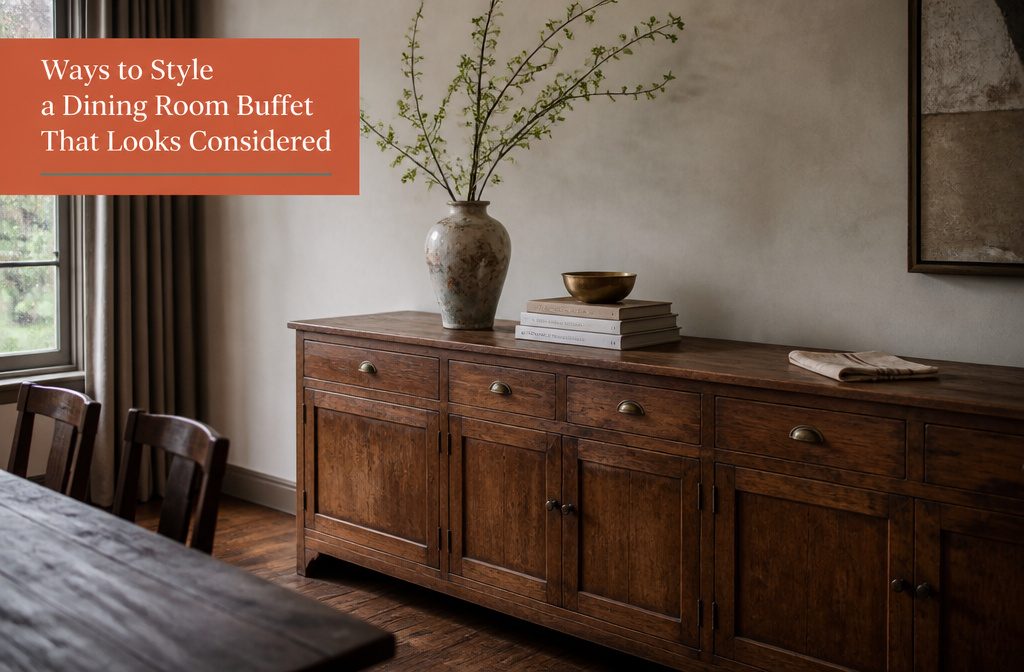
A buffet styled at all one height reads like a shelf, not a display.
The fix is three distinct tiers so the eye has somewhere to travel, but adding height only works if you also leave space: most approaches call for 60–70% of the surface empty, though some push that closer to 80%.
That breathing room is what keeps the piece functional when you need to set down a serving platter, and it is also what makes a few considered objects look intentional instead of crowded.
1. Choose a Focal Point or Backdrop
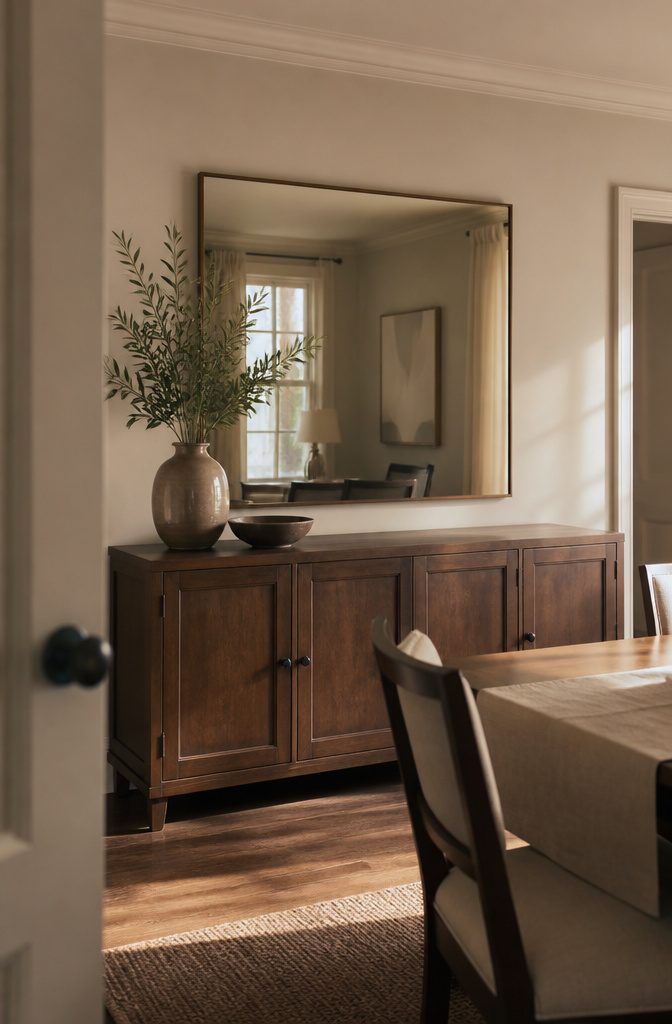
A mirror or piece of art above the buffet ties the wall and the surface together into one composition instead of leaving the furniture floating.
I reach for a mirror first in a small or darker dining room, since it reflects light and makes the room feel bigger. Art introduces color and can set the palette for everything on the buffet itself.
A good general rule of thumb to follow when styling your sideboard is to make the artwork around two-thirds of its width.
That proportion keeps the piece substantial enough to anchor the buffet without overwhelming it.
If you hang art, place it 6–8 inches above the cabinet top. If you lean it instead, you get a more relaxed look that works well for renters or anyone who doesn’t want to commit to nail holes.
Leaning also adds a bit more presence, since the frame sits closer to the surface and feels like part of the arrangement.
Centering the piece is the safest route, but nudging it slightly off-center can make the whole setup feel more lived-in and less symmetrical.
Just keep one clear focal point. A large mirror, a gallery wall, shelves, and several framed photos all competing for attention make one wall feel busier than the rest of the room.
2. Vary Height and Layer Objects
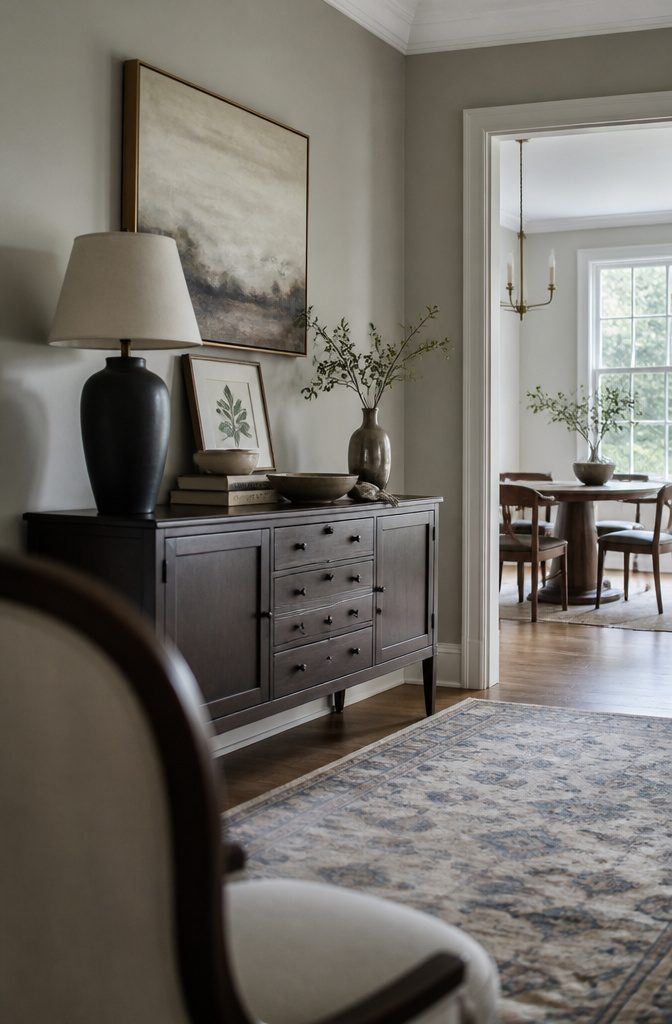
A buffet styled at one flat height reads like a shelf, not a display. The fix is three distinct tiers—tall, medium, and low—so the eye has somewhere to travel instead of skating across in a straight line.
A table lamp or tall vase anchors the top tier.
A stack of two or three books, a framed photo, or a pair of candlesticks fills the middle. A shallow bowl, a tray, or a small plant holds the front and keeps the bottom tier grounded.
The books do double duty: they are decor on their own and risers that lift smaller pieces into the middle height without looking like filler.
Step back and squint.
If the silhouette moves up and down in a way that feels like it exhales, the height mix is working. If everything lines up like a row at attention, reset and push one piece taller or pull one lower.
Balance is visual weight, not symmetry—a dark ceramic lamp on one side can be answered by a tall vase and a grouped object on the other.
3. Balance the Arrangement and Leave Open Space

Visual weight matters more than mirror-image matching. If you place a dark ceramic lamp on the left, balance it with a tall vase and a grouped bowl on the right rather than hunting for an identical twin.
You’re balancing around an imaginary center line, not building matching bookends.
Step back a few feet or snap a phone photo.
The frame shows you what your eye already suspects: one end feels heavy, or the whole surface reads as crowded. Fewer large pieces beat a parade of small ones.
How much surface to leave open depends on who you ask.
Some advocate for 60–70% empty, others push that to 80–90%, and a third camp suggests leaving a third bare or working a 60/40 split. The range reflects different priorities, but the principle holds: a buffet that looks considered needs room to breathe.
Preserving open space also keeps the top functional. When guests arrive, you need somewhere to set a serving platter, a pitcher of water, or a cheese board without reshuffling the entire arrangement.
4. Use Lighting
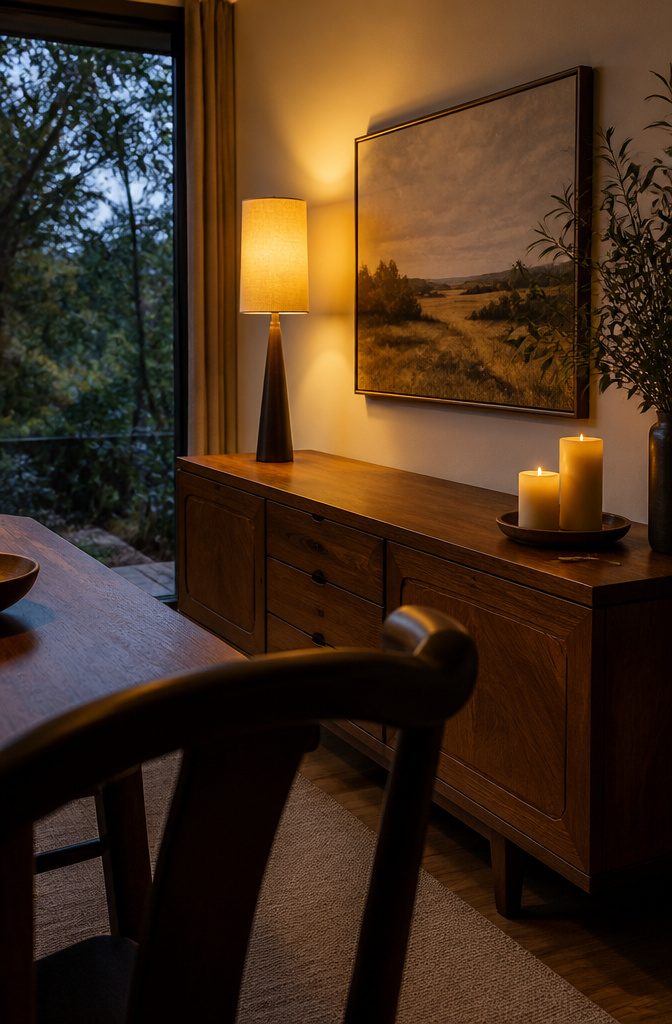
A lamp at either end or a pair of sconces on the wall behind the buffet warms everything the ceiling fixture flattens.
Buffet lamps sit 6–10 inches from the edge and stay tall and narrow so they don’t crowd the surface, and their finials should land just below the top of whatever art or mirror hangs behind them.
Leave 4–6 inches between the lamp and the frame so neither piece reads as jammed against the other.
Stick with 2700–3000K bulbs for that golden glow rather than the clinical white that turns dinner into a doctor’s office.
A dimmer helps if you want the room to shift from bright serving light to something softer once everyone sits down.
Candles layer in another level of warmth, but they need 12 inches of clearance above and a tray or plate underneath to catch wax.
Two pillar candles at different heights work harder than a scattering of votives that look sweet and leave drips everywhere.
5. Make It Functional
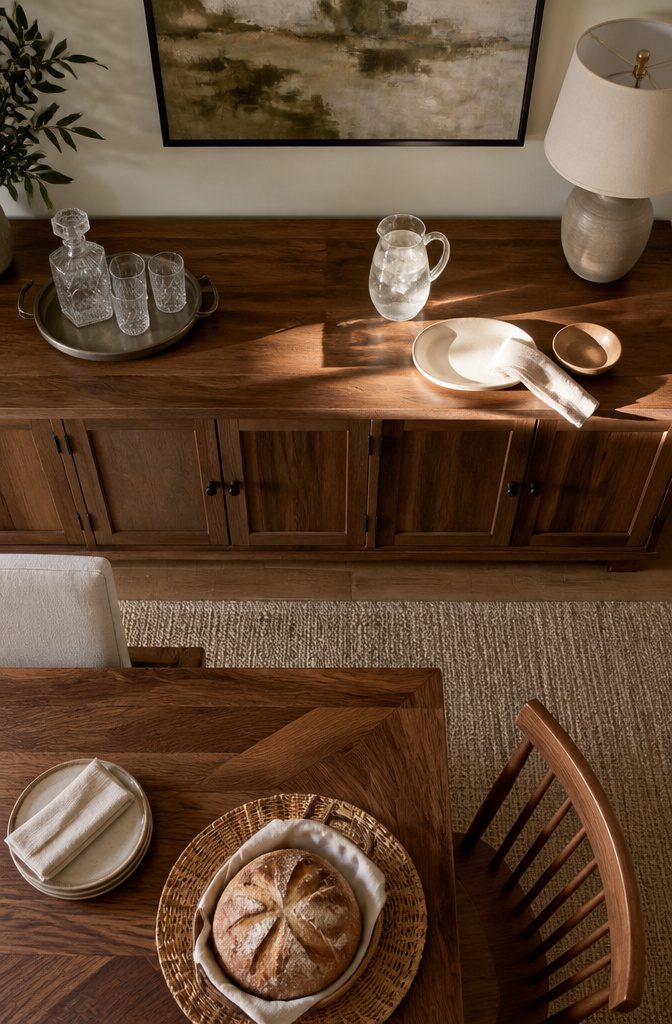
A buffet that just looks good is furniture you never use. Keep at least a third of the top clear so there’s room to set down a platter, a pitcher of water, or a cheese board when people are over.
The rest can hold a lamp, a tray with a few bottles and glasses, or a low arrangement, but that open zone is what keeps the piece functional instead of purely decorative.
Inside the cabinet, store the things you actually reach for: cloth napkins, candles, spare serveware, dinnerware, glassware, or the speaker charger nobody can find.
If you set up a bar or coffee station on top, tuck backup supplies behind the doors. Filters, beans, extra mugs, and anything in ugly packaging stay hidden so the surface doesn’t turn into a crowded counter.
A bar layout works best when you keep bottles, decanters, and glasses on one end and leave the other for a lamp or greenery.
The same goes for a coffee setup: machine and mugs on a tray, stored supplies inside, and the rest of the buffet styled like furniture.
During meals, use the surface as a serving hub for side dishes, bread baskets, or sauces so the dining table stays clear and guests can help themselves without reaching across each other.
6. Add Greenery or Natural Elements

A vase of branches or a potted fern softens hard surfaces and gives the buffet arrangement something alive to anchor on.
Fresh flowers work the same way, but they need replacing every week or ten days. I lean toward greenery that holds up longer: eucalyptus, olive branches, magnolia leaves in summer, or a low succulent dish that survives neglect.
Keep about six to twelve inches of clearance above any plant so stems do not crowd the ceiling or a piece of art hanging above the buffet.
For cut stems in a vase, three to five stems give you enough shape without the arrangement taking over the whole surface.
A potted fiddle-leaf fig or snake plant works in the same clearance range if the pot sits directly on the buffet rather than on a riser.
Seasonal branches bring texture without much effort.
Pussy willow in early spring, beech or oak in fall, and pine or cedar in winter all last two to three weeks in plain water and fill vertical space the way a tall candlestick would.
7. Group Objects in Threes

I group objects in threes because a triangle of different heights reads as one deliberate composition instead of three separate things sitting next to each other.
The tallest piece goes in the center or slightly off-center, and the other two step down around it at different heights. That triangular arrangement keeps your eye moving and makes the grouping look intentional rather than scattered.
If I don’t have a tall piece to anchor the triangle, I create height with a riser.
A stack of books, a decorative box, or even a small basket turned upside down lifts a shorter item just enough to complete the shape.
When I don’t have one large piece at all, I cluster a few smaller items close together instead. Grouped tightly, they read as one larger shape and give the same visual weight as a single substantial piece.
At least one group of three should anchor your buffet display. The science behind odd-numbered groupings runs deep, but the practical reality is simpler: they balance a surface without looking cluttered or scattered.
8. Coordinate Color and Materials

The buffet needs to feel like it belongs in the room, not like it parachuted in from a different house.
Repeat at least three materials already working elsewhere in the space: if your dining chairs have brass legs and the table is walnut, find a brass candlestick and a wood tray for the buffet. The overlap reads as intention.
Color works the same way. Let the cabinet itself be the accent—navy buffet, navy ceramics on top, a blue book spine under the lamp—or keep the cabinet neutral and let bold color live in the styling.
Either way, you’re tying the piece back to artwork, textiles or chairs a few feet away.
Contrasting finishes help more than matching everything.
A ceramic vase next to a metal lamp next to a woven basket gives the eye somewhere to travel. Add something organic—a branch, trailing greenery, dried wheat in a bowl—and the whole surface stops looking staged.
One worn piece helps: a vintage vase, a book with a softened spine, ceramics with visible throwing marks. Perfect is forgettable; slightly imperfect is the thing guests photograph.
9. Add Personal or Collected Pieces

Personal objects—photos, ceramics from travel, pieces passed down—turn a buffet from styled to lived-in. A vintage decanter set or a ceramic sculpture someone brought back from a trip sits differently than a piece bought to match the room.
The difference is not sentimental weight alone; collected objects usually vary in scale, finish, and color in ways that keep a surface from looking too controlled.
I mix functional pieces with meaningful ones rather than devoting the whole surface to memory.
A framed photo works when it fits the palette already running through the arrangement. A set of hand-thrown bowls from a local potter becomes part of the serving setup, not a shrine to the maker.
You want character without announcement: the buffet should feel like it belongs to someone, not like it is reporting on them.
Overloading personal pieces clutters fast.
Two or three items that matter read clearly. Six read like a clearance of a drawer.
10. Refresh the Display Seasonally

The buffet itself holds its ground. Anchor pieces stay put season to season: the lamps, the large arrangement that provides height, the mirror or piece of artwork that balances the wall.
What rotates are the smaller accents and natural elements that shift the mood without forcing you to rebuild the whole setup.
A branch of forsythia in spring or a few stems of dried wheat in fall can change the entire feel with very little effort.
Fresh blooms in a floral pitcher for spring, a citrus bowl or woven tray in summer, warm-toned candles and wood accents in autumn, evergreen sprigs and metallic details in winter.
The seasonal layer is small but purposeful, and it keeps the buffet current without chasing a strict color palette.
Let the season guide what you bring in rather than forcing everything to match. The foundation remains the same, the accent changes, and the buffet feels intentional year-round.
Buffet, Sideboard, or Credenza
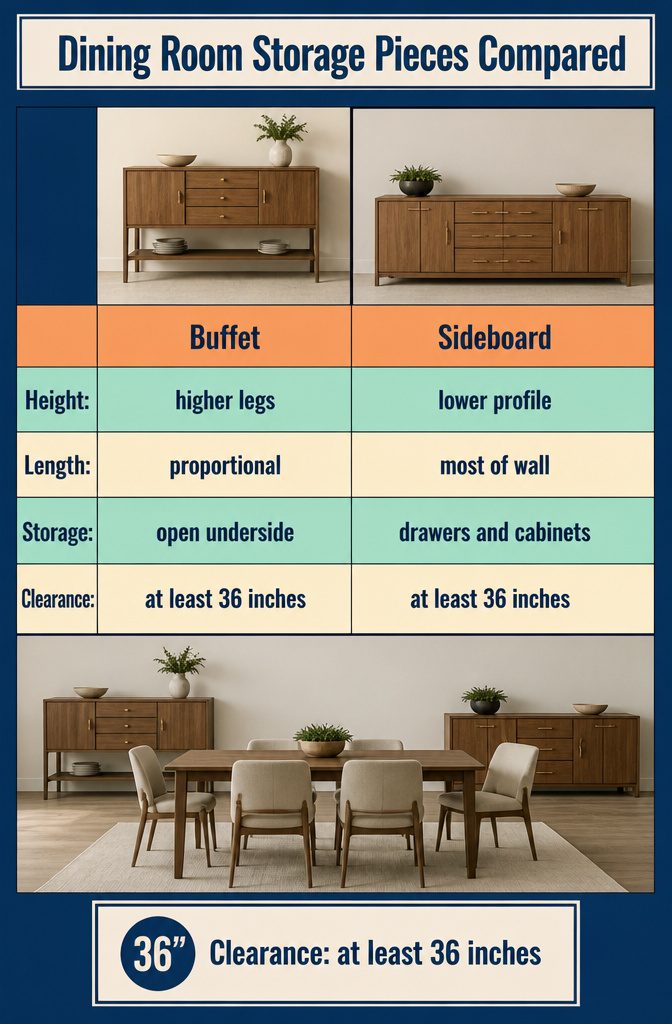
The terms get thrown around as if they mean the same thing, but buffet, sideboard, and credenza each describe a different piece.
A buffet sits on higher legs and was meant for serving, with open space underneath for tucking serving ware between courses.
A sideboard sits lower and longer, usually stretching most of the wall, and leans heavier on storage drawers and cabinets.
A credenza is shorter still, often backless or open at the rear because it was designed to sit against a window rather than a solid wall.
All three work in a dining room; which one you pick depends on what you need it to do and how much floor you have to give it.
Scale matters more than the label.
A buffet should feel proportional to the dining table without necessarily matching its length. In smaller rooms, a slim piece like the Vincent Buffet keeps the flow open.
Larger spaces can carry wider options like the Veronica Buffet or Monaco Buffet without crowding. Leave at least 36 inches between the buffet and the table edge so chairs can pull out without scraping the cabinet every time someone sits down.
Protect the Surface During Meals

A buffet that sees regular use needs protection built into the styling. Use trays, coasters, heat-resistant trivets, and a washable runner to guard against water rings, hot serving dishes, and candle wax before they leave permanent damage.
- Runner width: 12–16 inches, with 3–6 inches of overhang on each end for a traditional look, or stop it short for a cleaner line. The runner frames your arrangement and lets a little wood show on both sides.
- Keep trivets nearby—stored inside the buffet if space allows—so setup before guests is faster. They also add texture when layered under bowls or stacked casually between uses.
- Match your surface choice to how hard you actually use the space. A delicate finish works in a display-only room; a durable, easy-to-wipe surface handles frequent hosting without constant special care.
- Never place hot dishes, wet flower pots, or dripping candleholders directly on wood that requires maintenance.
Frequently Asked Questions
How can I style a buffet in my dining room?
Start with a focal point like a mirror or art on the wall, then arrange objects at 3 distinct heights using lamps, candlesticks, books, and trays.
Leave at least a third of the surface clear for function, add a layer of warm lighting, and group smaller items in threes to create visual triangles.
Repeat materials and colors from elsewhere in the room so the buffet feels connected rather than isolated.
What is the 3-5-7 rule in decorating?
The rule suggests grouping objects in odd numbers (3, 5, or 7 items) because asymmetrical arrangements feel more balanced and intentional than even-numbered pairs.
For buffets, grouping in threes works best: one tall piece with 2 shorter items around it creates a visual triangle that guides the eye without looking scattered.
Should a buffet be shorter than the dining table?
Buffets do not need to match the dining table length exactly. Focus on proportion to the wall and room size instead, and leave at least 36 inches between the buffet and table edge so chairs can pull out freely.
In smaller spaces, a slim piece maintains flow; larger rooms can handle wider options without crowding.
How do you decorate a narrow buffet table?
Choose tall, shallow pieces like slim lamps, upright branches, leaned artwork, and narrow trays that add height without eating up front-to-back depth. Keep the front edge clear so the surface can still hold a serving plate or drinks when needed.
How can you protect a buffet top during dinner parties?
Use trays, coasters, heat-resistant trivets, and a washable runner (12–16 inches wide) to guard against water rings, hot serving dishes, and candle wax.
Keep trivets stored inside the buffet for quick access, and never place hot dishes, wet pots, or dripping candles directly on wood.
Should I choose a buffet with drawers, doors, or open shelves?
Drawers work best for napkins, flatware, and small accessories; doors suit larger platters, bowls, and serving pieces; open shelves require keeping contents visually tidy at all times.
Most dining rooms benefit from a mix of drawers and closed cabinets for storage that stays functional and guest-ready.
How can a buffet work harder for you?
Use the surface as a bar setup with bottles and glasses on one end, a coffee station with machine and mugs on a tray, or a serving hub during meals for side dishes and sauces so the dining table stays clear.
Store backup supplies, spare serveware, dinnerware, and anything in ugly packaging inside the cabinet to keep the top functional without clutter.