
Indoor plants grow healthily when light, watering, soil type, and seasonal dormancy match what each species needs, which takes more observation than most guides admit.
The step people skip is measuring light where the plant will sit, because a spot that feels bright to you might deliver only 50 foot-candles when a "low-light" plant still needs 25 to 75 for eight hours a day.
1. Choose Plants That Fit Your Space and Time
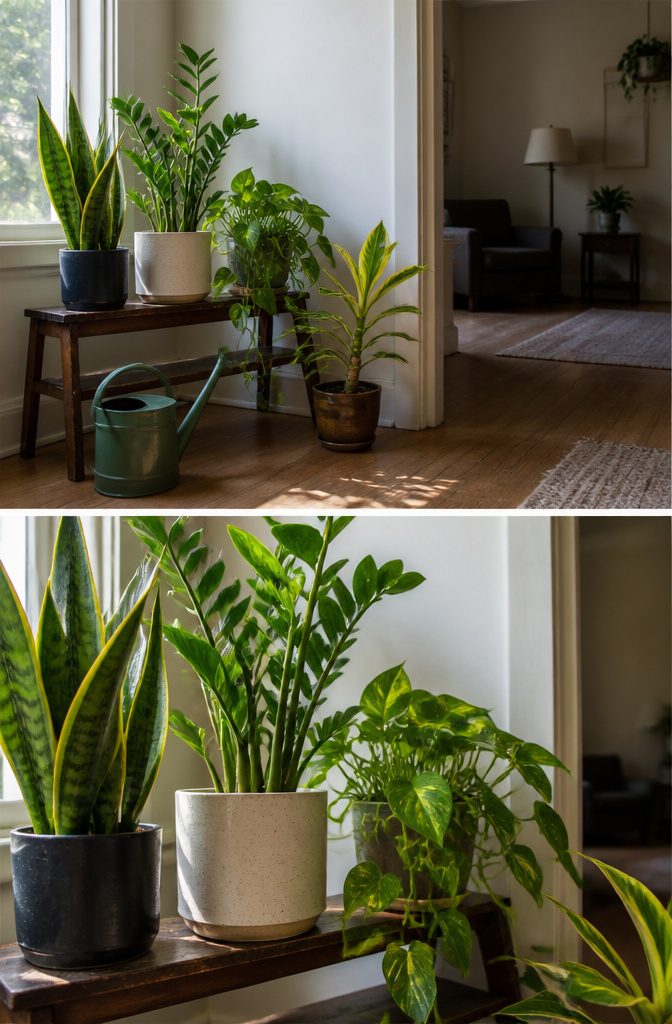
The light available in a room decides which plants will grow there, so start by looking at what you have before you pick anything.
A south-facing window gives enough brightness for succulents, cacti, and even herbs; a room with no direct sun narrows the field to plants that tolerate lower light.
The amount of time you can give matters as much as the room itself.
Snake plant, ZZ plant, golden pothos, and corn plant all handle inconsistent watering and survive benign neglect, which builds confidence if you are starting out or trying again after something died.
I recommend beginning with one or two plants rather than filling a shelf on day one, because you will quickly see which ones suit your space and how much attention you can actually give them.
If you have pets that chew on leaves or dig in soil, that limits choices too, so factor that in before you bring anything home.
2. Assess the Light Where the Plant Will Sit
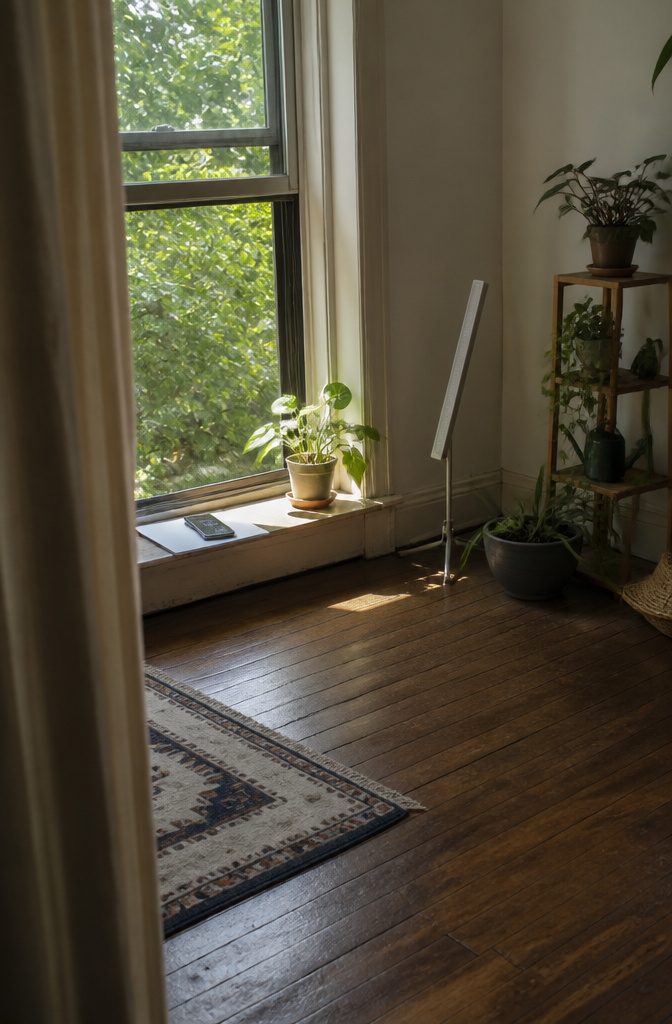
Light decides which plants live and which ones lean toward the window until they give up.
I measure it before I choose anything, because a plant labeled "low light" still needs 25 to 75 foot-candles for eight hours a day, and what feels bright to you might be a tenth of that.
The camera method works if you have a 35 mm body lying around.
Set it to ASA 25 film speed and a shutter speed of 1/60th of a second, aim it at white paper where the plant will sit, and adjust the f-stop until the meter shows correct exposure.
An f-stop of f/5.6 gives you around 400 foot-candles; f/16 puts you at 2,400.
A light-meter app does the same job faster, and I use one now to check spots a few feet back from the window, where the reading drops hard even with southern exposure.
Four categories matter.
Low light runs 25 to 75 foot-candles. Medium goes 75 to 200.
High light is anything over 200 without direct sun. Sunny means at least four hours of direct sun hitting the plant, which only happens near an unobstructed south or west window in most homes.
Eastern windows give strong morning light that fades by noon, and northern windows stay dim year-round.
Plants tell you when the light is wrong.
They lean toward the source, stretch between leaves, or drop lower leaves first. If the room cannot give them what they need, a grow light fills the gap.
3. Water When the Soil Needs It, Not on a Schedule

Check the soil about an inch below the surface before you water. If it feels dry at that depth, the plant is ready for a drink.
If some moisture is still there, wait a few more days and check again. Watering on a fixed calendar ignores what the plant actually needs, and needs shift with light, temperature, the size of the pot, and the season.
Overwatering kills more houseplants than underwatering does.
Too much water drowns the roots and cuts off the air they need, leading to rot. Underwatered plants droop and recover once you give them water; overwatered plants often do not come back.
When you do water, soak the soil thoroughly until water drains from the bottom, then discard what collects in the saucer to prevent salt buildup and root damage.
Not all plants want the same schedule. A croton in bright light dries out faster than a succulent in the same spot.
Cacti may not need any water from November through March. Drainage matters more than precision, because a pot with a hole accounts for the times you guess wrong.
4. Use the Right Growing Medium and a Pot With Drainage

Most houseplants do well in a general potting mix, but succulents and orchids need something that drains faster.
A standard mix keeps moisture in longer, while cactus or succulent mixes move water through quickly and prevent roots from sitting wet. Orchid mix is chunkier still, with bark and other coarse material that lets air reach the roots.
All three should fall within a pH of 5.0–6.5, which most bagged mixes hit without adjustment. Miracle-Gro Indoor Potting Mix works for the majority of plants; swap it for their Cactus, Palm & Citrus mix if you’re planting jade or aloe.
Whatever mix you choose, the pot needs drainage holes at the bottom.
Without them, water pools and root rot follows. If you want a decorative pot that has no hole, drop a plastic nursery pot inside it and water that one instead, lifting it out to let excess drain.
When you bring a plant home, let it sit in its nursery pot for a week or two while it adjusts to the new light and humidity.
When you do repot, choose a container about two inches larger than the current one.
Loosen any roots circling the inside of the old pot before you move it, water thoroughly once it is settled, and repeat the two-inch step-up each time the plant outgrows its space.
5. Keep Temperature and Humidity in Range
Most houseplants settle in comfortably at 70–80°F during the day and 65–70°F at night, the same range that keeps homes comfortable for people.
Some sources bring that daytime span down to 65–75°F, which still covers the overlap where nearly everything thrives.
The bigger risk is placement near cold drafts or hot air vents, where sharp swings stress plants faster than steady temperatures a few degrees outside the ideal.
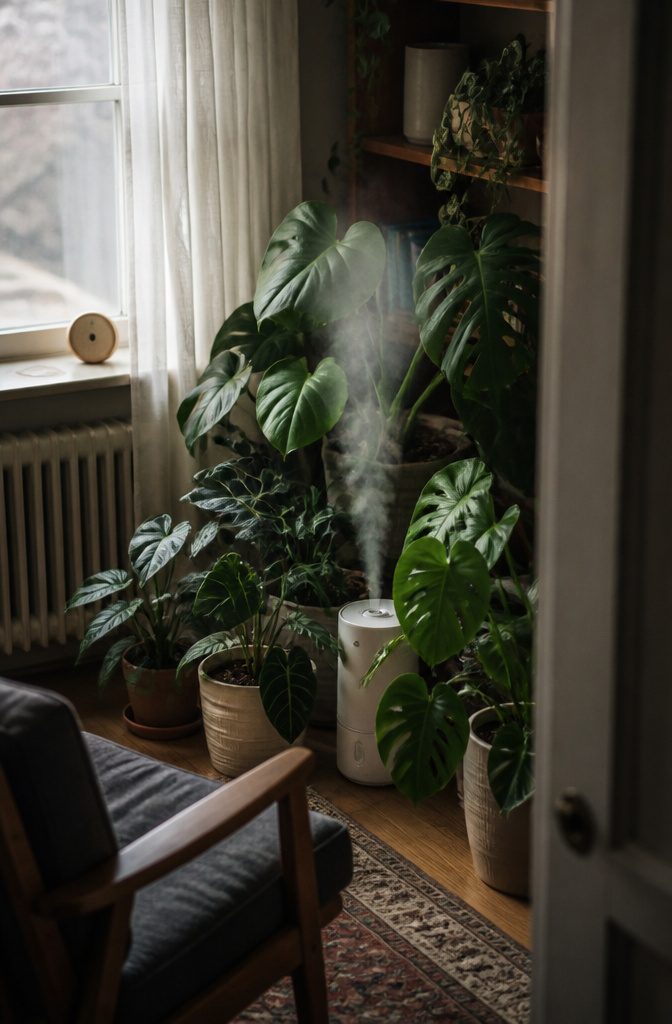
Humidity matters more than temperature for most tropical houseplants, and winter heating drops indoor air to 20–30% relative humidity when plants prefer closer to 50%.
Below 20% counts as low, 40–50% as medium, and above 50% as high. Grouping plants together raises the local humidity slightly as they transpire.
A humidifier does the job more reliably if the air stays dry for weeks at a stretch, and it beats misting, which would need to happen every few minutes to make a real difference.
6. Feed During the Growing Season
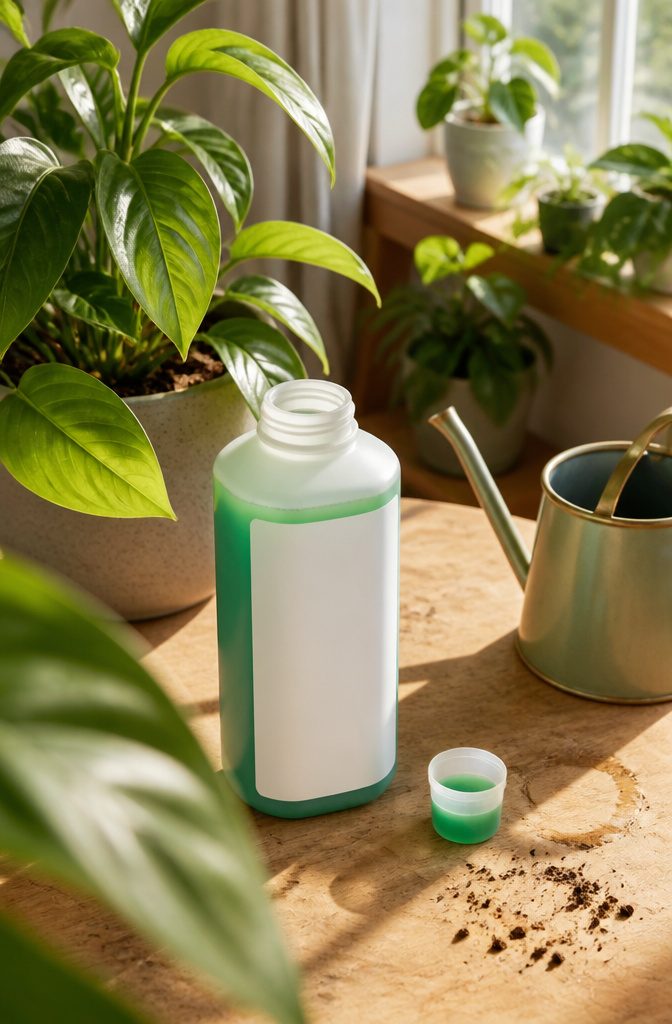
Plants grow most actively in spring and summer, and that is when they need fertilizer.
I use a balanced liquid fertilizer once a month during those seasons, then skip feeding entirely in fall and winter when growth slows or stops. Pushing fertilizer during dormancy does more harm than good.
Most liquid fertilizers meant for outdoor or general gardening are too strong for indoor plants.
If you are using one of those, dilute it to one-quarter to one-half the label dosage to avoid burning the roots. Fertilizers labeled specifically for indoor plants already come at lower concentrations, so you can follow their instructions as printed.
Overfed plants show dark green leaves that are smaller than normal, with long gaps between nodes.
Underfed plants turn pale or yellow and grow slowly. If you see yellowing, bump feeding to every two weeks at the same diluted rate.
Once a month, water the plant heavily enough that water runs through the drainage holes. That flush clears out any fertilizer salts that have built up in the soil.
Air Circulation Moves Moisture and Limits Mold

Indoor plants grow stronger when air keeps moving around them. Still air lets moisture sit on leaves and soil long enough for fungal problems to start, and improving circulation solves that without needing fungicides or constant vigilance.
A fan running a few hours a day in the room where you keep plants dries soil faster, limits mold on both leaves and growing medium, and moves enough air to help with pollination if you’re growing edibles indoors.
A light, steady flow prevents stagnant pockets without the force of wind. I check whether airflow is adequate by watching how long soil stays wet after watering.
If it takes more than a day or two longer than it should for the plant type, a small electric fan on a timer usually fixes it.
Placing plants near a window works too, since temperature shifts through the day create light air movement without needing equipment.
Watch for Pests and Respond Early

Spider mites, aphids, and mealybugs are the pests I see mentioned most often, and catching them early makes all the difference.
Yellow spots on leaves can point to spider mites or scale, so I check closely when discoloration shows up. Wiping leaves with a damp cloth during regular cleaning often catches the problem before it spreads.
For an active infestation, soapy water works—a few drops of dish soap in a spray bottle, applied to the leaves and wiped off after a few minutes. Insecticidal soap is another option if the infestation is heavier.
The moment I spot pests on one plant, I move it away from the others. Isolating an affected plant stops aphids or mites from jumping to healthy neighbors while treatment does its work.
Prune and Propagate to Keep Plants Healthy or Start New Ones
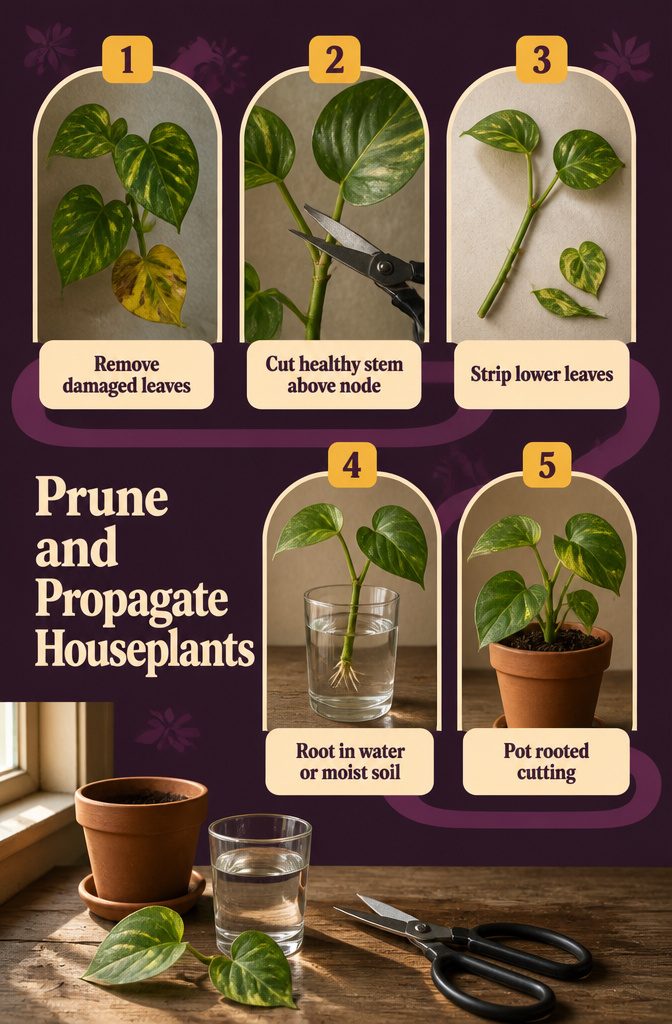
Pruning keeps houseplants compact and directs energy away from damaged tissue and toward new growth.
I check for yellow, dead or damaged leaves every week or two and snip them off with clean scissors, cutting just above a node or back to the main stem.
Trimming leggy growth on pothos or philodendrons encourages bushier structure instead of long, sparse vines.
The cuttings themselves become new plants: I take a healthy stem with at least two nodes, strip the lower leaves, and place it in water or directly into moist soil.
Not all houseplants root in water, and the water on those that do needs changing every few days to prevent rot.
Plantlets that form on spider plants or mother ferns can be removed once they develop small roots and potted on their own.
Propagation multiplies what I already have without spending anything, and rotating a plant every few weeks corrects the lean toward the light.
Adjust Care for Dormancy and Seasonal Changes

Growth slows or stops entirely during dormancy, and most indoor plants enter that phase from December through February in the United States.
During those months, reduce watering and stop fertilizing. The plant is resting, not dead, and pushing food or moisture at it when the roots are barely active invites rot.
Winter conditions inside the home change too. Rooms get cooler and drier, especially near windows.
If a plant sits on a sill, move it back from the glass where cold drafts settle. Growth slows in lower temperatures, so water less often than you did in summer.
Summer brings the opposite problem. Higher temperatures dry soil faster, and you may need to water twice as often.
Light also shifts with the seasons. A south-facing window that gives gentle winter sun can scorch leaves by July.
Pull plants back a few feet if they start to bleach or curl. In winter, move them closer to the glass or shift them to a brighter room if growth stalls and the color fades.
Growing Food Indoors Takes More Light and Attention

Growing food indoors means committing more resources than you would to a pothos or a snake plant.
Leafy greens such as spinach, kale, and arugula are the simplest place to start: they grow in four to six weeks and need moderate light for 12 hours a day, a temperature around 60°F, and lights positioned 12 to 16 inches above the plants.
Herbs require moderate-to-high light for 12 to 16 hours daily.
Fruiting crops—tomatoes, peppers, anything that flowers and sets fruit—demand more time and equipment than leafy crops, including lights positioned six to 12 inches above established plants, fertilizer every two weeks, and around 50% relative humidity.
I would grow a few rounds of greens before moving to fruiting plants.
Containers matter, too: radishes need at least 10 inches of depth, jade plants need a drink every two to three weeks, and wheatgrass is ready in seven days if you want something fast.
Clean Leaves Every Few Weeks So They Can Breathe

Dust blocks light from reaching the leaf surface, and light is how a plant makes food.
I wipe leaves with a damp cloth every few weeks to keep that layer from building up. The difference shows: a dusted fiddle-leaf fig pulls in more light than one carrying a film of particles, and the plant grows accordingly.
A soft cloth dampened with plain water does the job.
I support each leaf from underneath with one hand and wipe gently with the other, working from the base toward the tip. Large-leafed plants like rubber trees and monsteras benefit most, since their broad surfaces catch more airborne particles.
Plants with small or textured leaves take longer to clean individually, so I rinse those in the sink or shower when they need it.
The habit also gives me a chance to inspect for pests.
Spider mites and scale insects often appear on the undersides of leaves, and I catch them early when I’m already handling each one. A clean leaf breathes better, photosynthesizes more efficiently, and shows problems before they spread.
Frequently Asked Questions
What are the easiest indoor plants for beginners?
Snake plant, ZZ plant, golden pothos, and corn plant all handle inconsistent watering and survive neglect. They tolerate lower light and forgive mistakes, which makes them ideal if you are starting out or have killed plants before.
How many houseplants should I start with?
Start with 1 or 2 plants rather than filling a shelf on day one. You will quickly see which ones suit your space and how much attention you can actually give them.
How often should I water indoor plants?
Check the soil about an inch below the surface before you water.
If it feels dry at that depth, the plant is ready for a drink. If moisture is still there, wait a few days and check again.
Why are my plant’s leaves turning yellow?
Overwatering and insufficient light are the most common causes. Let the soil dry out between waterings and move the plant to a brighter spot if it is not getting enough light.
Can I use tap water for houseplants?
Yes, tap water works for most houseplants. Letting it sit overnight before watering helps, and some sensitive plants prefer filtered water.
What should I do if I see bugs on my plants?
Wipe leaves with a damp cloth. For active infestations, use soapy water or insecticidal soap, remove damaged leaves, and isolate the plant from others until the bugs are gone.
Do indoor plants need fertilizer?
Plants need fertilizer during spring and summer when they grow most actively. Use a balanced liquid fertilizer once a month during those seasons, then skip feeding entirely in fall and winter when growth slows or stops.
Can you grow vegetables indoors year-round?
Yes, you can grow a variety of vegetables indoors at home all year. Leafy greens are the simplest place to start, while fruiting crops like tomatoes and peppers demand more light, time, and equipment.
What helps indoor plants grow faster?
Adequate light, proper watering, feeding during the growing season, and good air circulation all speed growth.
A plant in the right light with consistent moisture and monthly fertilizer in spring and summer will grow faster than one missing any of those.