
I’ve battled dog urine on my oak floors more times than I care to count, and I’ve learned speed beats any fancy product every single time. First, I press a dry white cloth for five minutes to check how deep the damage goes. Yellow stains mean trouble’s brewing beneath the surface. Then I blot like my life depends on it, working from the outside in with plain white towels until they’re bone dry. Next comes the enzyme cleaner, which I saturate completely and let sit for at least fifteen minutes so those hungry enzymes can literally digest the urine proteins causing that 3 AM stench. I blot again, sniff from multiple angles like a bloodhound, and if odor lingers, I hit it with vinegar solution; just a quarter-cup per gallon, tested on a hidden spot first. For stubborn cases, baking soda becomes my best friend, sprinkled over damp areas and vacuumed once dry. When nothing else works and the boards have cupped or turned soft, I grab my sander starting with 120-grit paper, working gradually until I hit clean wood fibers before refinishing with matching stain and sealant. Finally, I place washable mats near water bowls and keep paper towels stashed in every room because prevention costs significantly less than another sanding marathon.
Assess How Deeply Dog Urine Has Soaked Into Your Hardwood
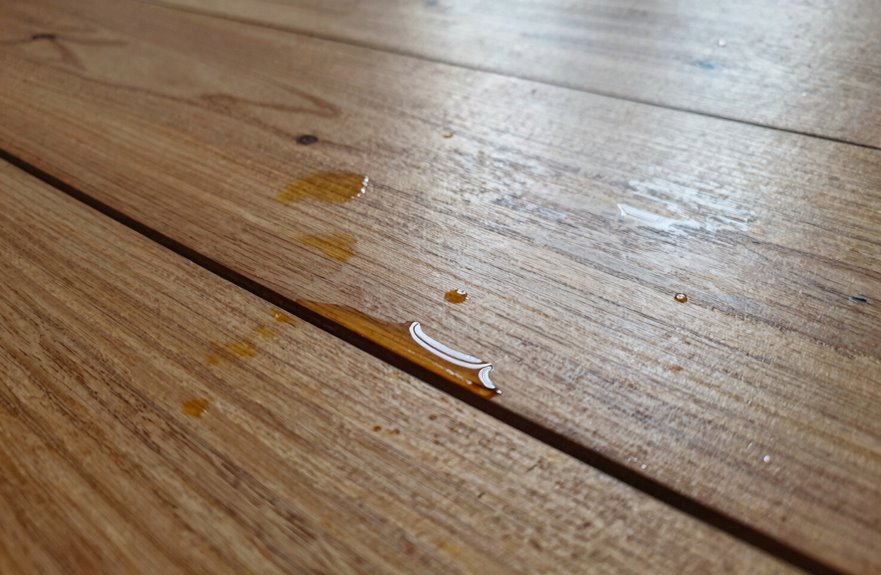
How badly has your pup’s accident wrecked your gorgeous floors. I’ve been staring at that dark patch wondering if we’re talking surface scuff or total disaster.
First, I do a quick depth assessment. If that stain’s wicking into the seams like coffee into a paper towel, we’ve got urine penetration beyond the pretty top layer. I press a dry white cloth down for five minutes, moisture testing 101, and if it comes up yellow or damp, yep, we’re past the surface vs. subfloor boundary.
Persistent odor after wiping indicates the stuff’s hit your subfloor, maybe even the underlayment. I check for cupping, that raised grain that feels like tiny speed bumps under bare feet. Soft spots mean deeper trouble. Shield the area now; no soaking or you’ll swell the wood worse.
Lift Surface Residue Before Treating Dried Stains
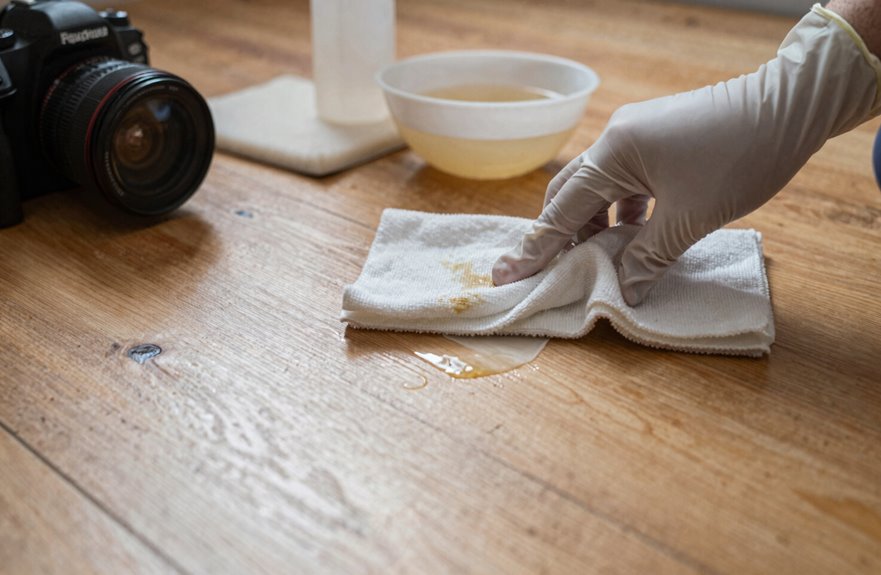
Now that I’ve scoped out the damage, I’m grabbing my weapon of choice: a plain white towel, nothing fancy, the kind I stole from my mom’s house years ago. Dried stains are deceptive, pretending the mess is just skin-deep when it’s not. I’m blotting, not rubbing, working from the outside in so I don’t turn a small disaster into a Jackson Pollock situation. The goal is moisture removal, plain and simple. I’ll absorb every drop of surface residue I can before those enzymatic cleaners even touch the floor. No moisture on my towel means I’ve done my job. Skip this step, and you’re basically sealing urine into your beautiful hardwood. Ventilate, dry, then proceed with the deep treatment.
Apply Enzyme Cleaner to Break Down Soaked-In Urine
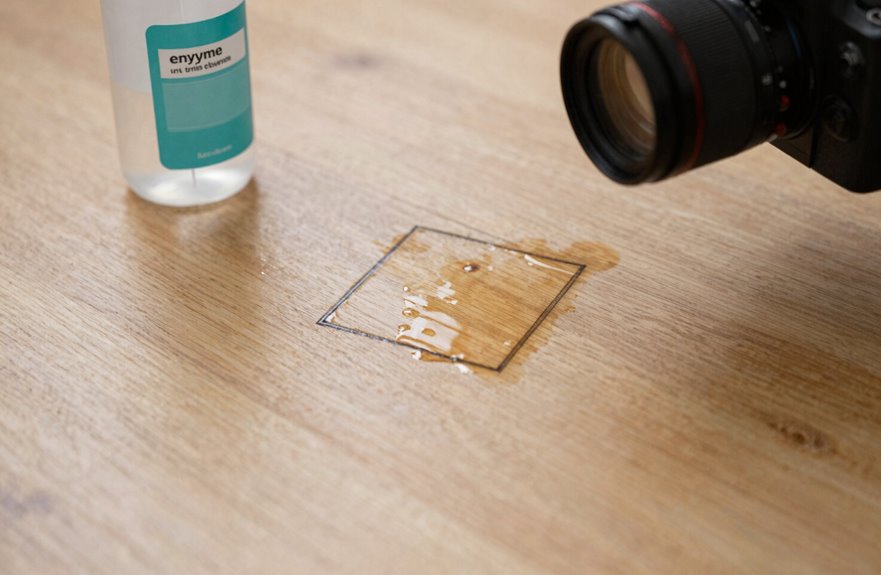
I saturate the stain completely, letting that enzymatic cleaner seep deep into the wood grain where the real damage hides. Think of it as sending tiny Pac-Men to gobble up those stubborn urine proteins. I’ll wait, checking my watch every ten minutes, until the enzymes finish their microscopic feast. If that first round doesn’t banish the smell entirely, I’m ready to reapply, dry thoroughly, and repeat until my hardwood smells like home again, not a kennel.
Enzyme Action Process
Because that stain isn’t going anywhere on its own, I need to bring out enzyme cleaners, my essential tool for when urine has really sunk into the grain.
I reach for non-toxic enzyme cleaners specifically designed for pet urine, because my hardwood floors deserve better than harsh chemicals that will wreck the finish. Here’s my approach:
- Test a hidden spot first. I learned this lesson on my bathroom threshold.
- Apply saturation levels that really soak into the grain, no skimping.
- Respect the dwell time. 15 minutes minimum, I set a timer and walk away.
- Skip the bleach and ammonia entirely. They’ll cancel everything out and possibly damage your floors.
That dwell time is critical. The enzymes literally eat the urine proteins, making odor removal actually possible.
Drying and Reapplication
Where exactly do enzymes need to go to work? Right into the heart of that urine stain. Saturate the spot with enzyme cleaner, letting those proteins break down the organic compounds. Fifteen minutes, then wipe without rinsing.
| Step | Action | Timing |
|---|---|---|
| 1 | Saturate urine stain with enzyme cleaner | Immediate |
| 2 | Let enzymes penetrate hardwood floors | 15 minutes |
| 3 | Wipe excess, assess for reapplication | Post-wait |
| 4 | Allow complete drying, ventilate space | Hours |
| 5 | Repeat cycle for stubborn odor elimination | As needed |
Rushing the drying process allows odor to return. Incomplete drying leaves moisture that reactivates urine salts. Allow adequate drying time between applications and ensure proper ventilation. Reapply the enzyme treatment as needed for stubborn odors. Complete drying between cycles prevents the smell from resurfacing.
Extract Moisture and Evaluate If Odor Persists
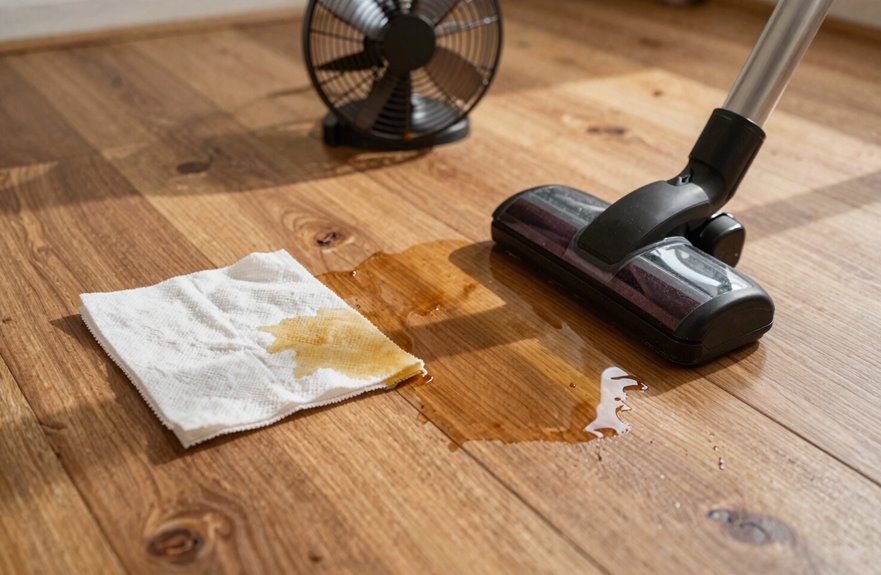
I grab a stack of clean, white towels—none of that fancy patterned stuff, you need to see what you’re pulling up—and press down hard, really leaning into it, because that liquid’s still hiding in the grain. Once I’ve blotted until the towels come up barely damp, not soaked, I get down on my hands and knees and take a long, suspicious sniff right at the boards to check if that sharp ammonia tang still lingers. If my nose wrinkles, if there’s even a whisper of wet dog park odor still hanging around, I know the finish has soaked it up like a sponge. This means the enzyme treatment wasn’t sufficient, and sanding down to bare wood becomes necessary.
Blot Excess Liquid Immediately
The second you spot that telltale puddle, I’m already on my knees with a stack of paper towels. Speed saves your hardwood floor from serious damage, so follow this process:
- Blot, don’t rub. Press firmly to lift urine without grinding it deeper into the grain.
- Grab fresh towels repeatedly until zero moisture transfers, no matter how many it takes.
- Keep water far away during this stage; we’re cleaning dry-style to protect that finish.
- Peek underneath rugs nearby. Odor loves to hide where we don’t look.
That persistent whiff afterward indicates the damage went deeper than surface level, but we’ll tackle that next. For now, dry cleaning prevents the urine from setting into the wood.
Assess Residual Odor Strength
How do you know when it’s truly over? I’ve learned the hard way that blotting alone doesn’t tell the whole story. After I press those towels down, really lean into it, I run my palm across the grain. Damp means trouble’s lurking. That’s when I start the sniff test, nose practically kissing the boards from three angles (yes, I look ridiculous, and yes, it works). The moisture check spreads to neighboring planks too, because urine’s sneaky like that. I rate the odor intensity without wishful thinking, then grab my notebook for documentation. Future decisions about next steps depend on accurate assessment records.
| Odor Level | Moisture Feel | My Honest Reaction |
|---|---|---|
| Faint whiff | Dry to touch | “Maybe I’m free?” |
| Moderate funk | Slight dampness | “Ugh, we meet again.” |
| Strong ammonia | Wet planks | “This is personal now.” |
| Lingering in grout | Seepage visible | “Calling reinforcements.” |
| Ghost scent returns | Hidden damp spot | “I knew it, I knew it.” |
Determine Next Treatment Step
So what’s the verdict—did I win this round, or are we going again? I’ve been staring at that dark spot wondering if my floors are doomed. Here’s how I figure out my next move:
- Blot thoroughly, getting every drop of moisture out before it warps the oak
- Test any enzyme cleaner on a hidden corner first; nobody wants finish damage right in the middle of the room
- If that odor still lingers, saturate the spot, wait 15 minutes, wipe, then add another thin layer
- Still stinky? Moisture extraction only goes so far. Sometimes you need to sand and refinish
This approach will resolve the problem, even when the wood fights back.
Remove Lingering Dog Urine Smell With Vinegar or Baking Soda
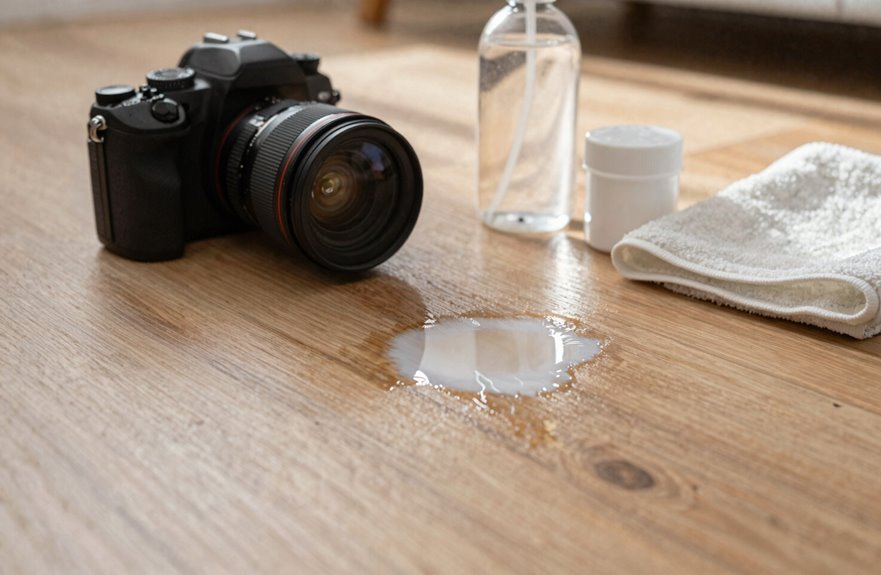
Why does that ammonia stench keep haunting my hallway like a bad ex? Vinegar is an effective secret weapon against urine odor clinging to wood floors. Mix one-quarter cup white vinegar into a gallon of warm water. This simple, cheap solution neutralizes that ammonia smell.
Before applying it to your floors, always test the solution on a hidden spot first. For serious stink zones, sprinkle baking soda thickly over damp areas, let it sit until dry, then vacuum. The chemical reaction between the baking soda and urine odor eliminates the smell. Dampness control matters because soggy wood warps, creating a wavy, ruined appearance.
Sand and Refinish When Urine Has Damaged Wood Fibers
Start hardwood sanding with 120-grit paper, keeping it gentle to prevent edge chips.
Progress gradually, removing just enough material to banish pet urine stains without damaging your floor.
Vacuum every speck of dust, then let that wood breathe completely dry.
Apply matching stain and wood floor sealant to refinish wood floors.
When the cleaning process fails, professional refinishing becomes necessary. Professionals use industrial sanders and color-matching equipment that produce superior results. The cost of refinishing is less than replacing hardwood flooring entirely.
Prevent Future Dog Urine Damage to Your Hardwood Floors
After all that sanding and staining, the restoration process is exhausting. Prevention is essential for protecting your hardwood floors.
Quick blotting is critical. Keep paper towels in every room. When pet urine occurs, respond immediately by pressing firmly on the affected area without rubbing. For odor neutralization, enzyme cleaners are highly effective because they break down the proteins in urine rather than masking the smell. Test any cleaner on hidden spots first to avoid damage like the cloudy patch that can appear on finished surfaces.
Ventilation reduces moisture and odor. Open windows regularly, even during winter months. Regular cleaning removes scent markers that may attract repeat accidents. Place washable mats near water bowls to contain spills and protect surrounding flooring.
These steps work together to protect your hardwood floors from urine damage.