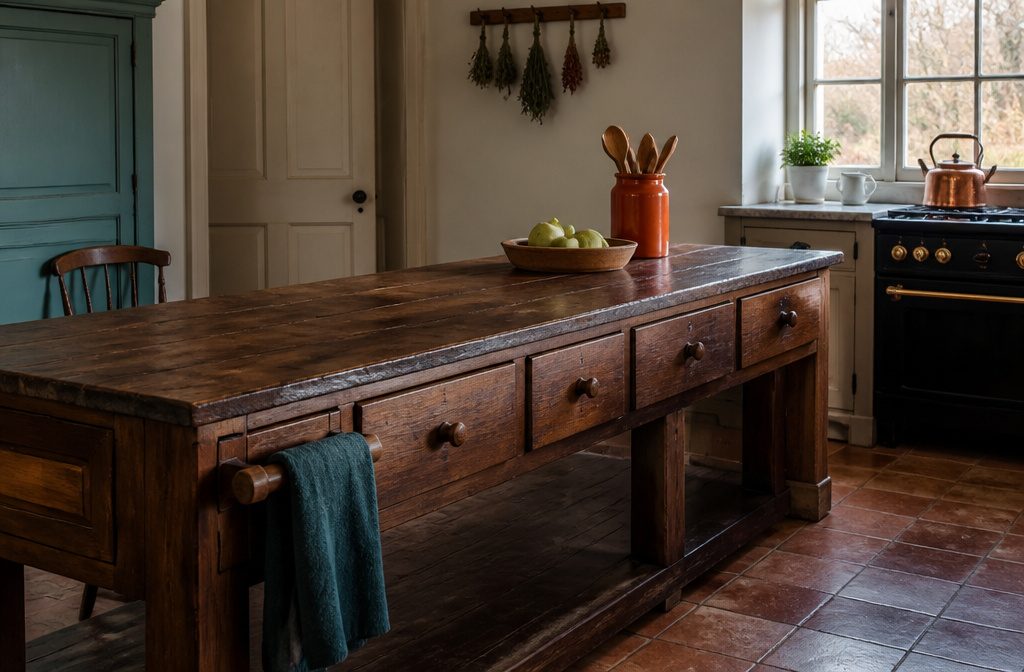
Decorating a kitchen island without blocking the work surface means choosing pieces you can move in seconds or leaving most of the counter bare.
A tray lifts in one motion when you need space for meal prep, and a single tall vase clears faster than five small objects scattered across the surface.
Williams Sonoma’s $79.95 porcelain utensil holder sits within reach while you cook and reads as deliberate rather than leftover clutter.
1. Use a Tray or Basket to Group Decor
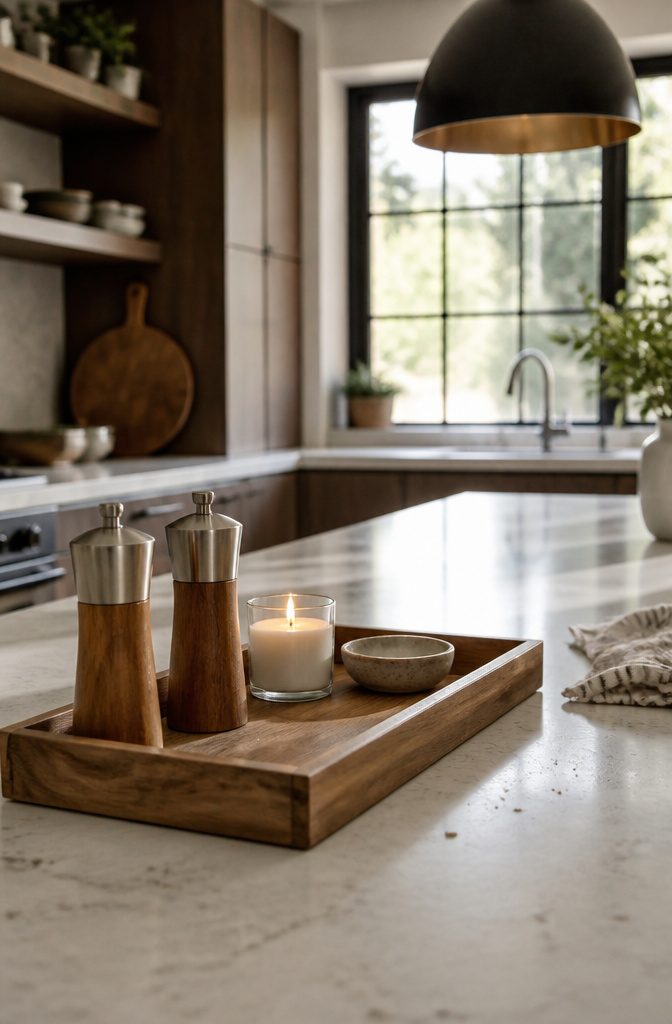
A tray or basket keeps small objects from reading as clutter and turns any collection into a vignette that feels planned instead of forgotten.
When salt shakers, a candle, and a small bowl live on a tray, they belong together. Without it, the same pieces look like they landed where someone set them down.
The containment works two ways. Visually, the edge gives the arrangement a boundary, so your eye registers one grouping instead of three orphaned objects.
Practically, you can lift the whole tray and clear the island in one motion when you need the counter for meal prep or serving.
That speed matters more than it sounds: a decorative setup that takes five minutes to dismantle is a decorative setup that stays in the way.
Material follows your style.
Wood trays suit warm, rustic kitchens; metal or ceramic fits cooler finishes. Thrift stores stock both in enough shapes and sizes that finding one to match the island’s proportions costs less than buying new.
2. Add Fruit, Vegetables, or Other Seasonal Produce

A bowl of fresh fruit or seasonal vegetables adds color and an edible function that pure decor cannot.
Apples, citrus, or stone fruit stacked in a simple bowl or woven basket give the island a farmstand look while reminding you to use what you bought.
The display works hardest when it reflects what is actually in season: citrus in winter, stone fruit in summer, small pumpkins or squash in fall.
The rotation keeps the look from getting stale. A bowl that holds lemons one month can hold clementines or pears the next, and the same vessel moves through the year without requiring storage space between uses.
I prefer a rotating fruit bowl when the island sees heavy use, since it lets anyone reach what they want without rearranging the whole display.
For smaller islands or tight counters, one bowl is enough to anchor the space without crowding the work zone.
3. Use Flowers, Greenery, or Plants
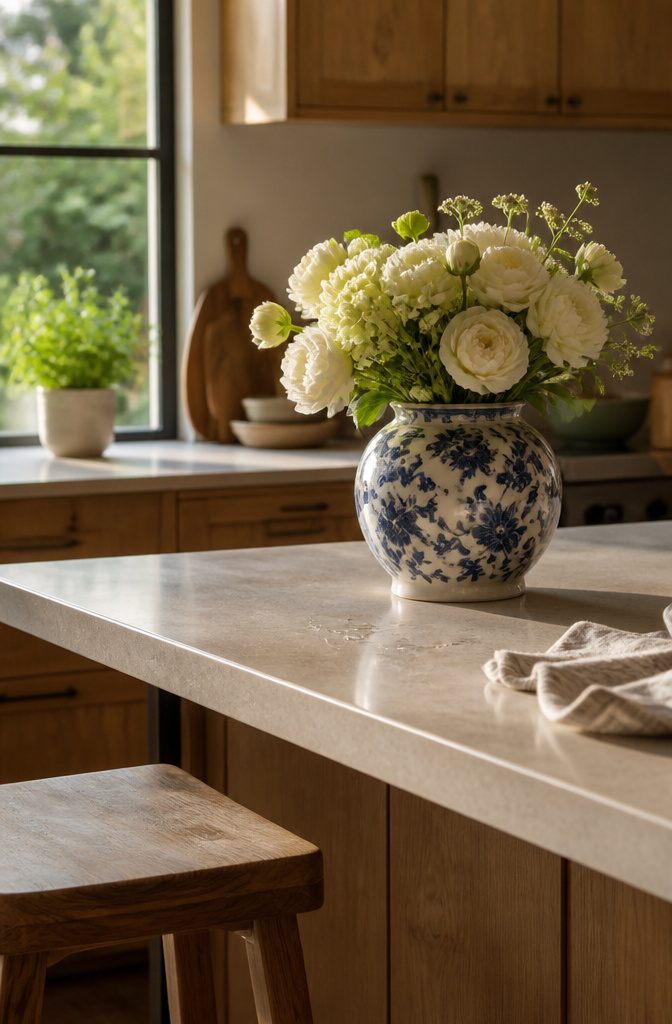
Flowers and greenery bring height, color, and a natural focal point to the island without taking up much counter space.
A vase filled with fresh blooms or a potted herb softens the hard surfaces around it and makes the kitchen feel more welcoming the moment someone walks in.
Three bunches of flowers from the grocery store run about $15, and they stay fresh for a week if the water gets changed every few days.
For something that lasts longer, a potted succulent or a small herb like basil or rosemary works just as well and doubles as an ingredient when dinner needs it.
The vase or pot matters more than it seems: a woven planter keeps the look casual, while a ceramic pot in blue and white reads more traditional.
Scale plays a role, too.
A compact arrangement fits on an island that gets heavy use, but if the island sits in an open floor plan with room to spare, a taller plant like a 79-inch palm can stand beside it and frame the space from the floor up.
Both approaches work; the right one depends on how much prep happens on that surface and how much visual weight the room can handle.
4. Choose One Statement Piece or Keep the Display Minimal
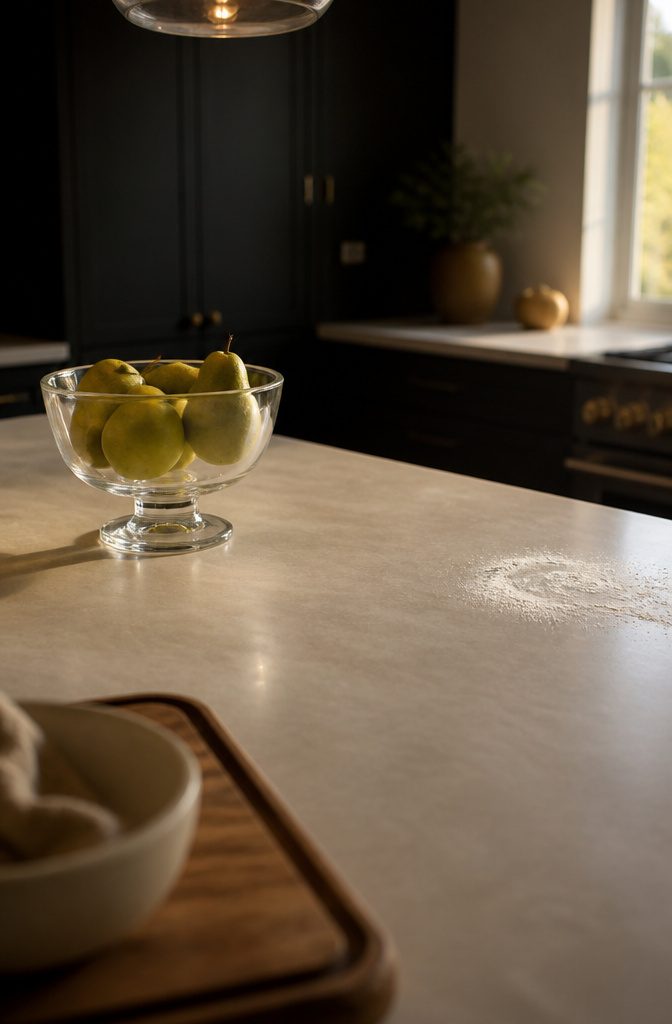
A large bowl on its own can carry the whole surface.
A ceramic bowl filled with fruit or a tall vase with greenery gives you one clear focal point instead of several competing pieces, and when you need the counter for meal prep, you move one thing rather than rearranging a collection.
The scale matters more than the number of objects.
Zero in on a single decorative accent for the island—anything more could end up feeling cluttered when you set out to meal prep or lay out a spread of hors d’oeuvres when hosting.
That single piece works best when it reads as intentional rather than leftover.
A statement vase tall enough to hold long branches or a footed glass bowl wide enough to anchor the space both do the job without making the island feel crowded.
If the look feels too spare, two or three pieces grouped together usually finish the surface without taking over. More than that and the styling starts to look like work instead of use.
5. Display Useful Kitchenware and Everyday Items
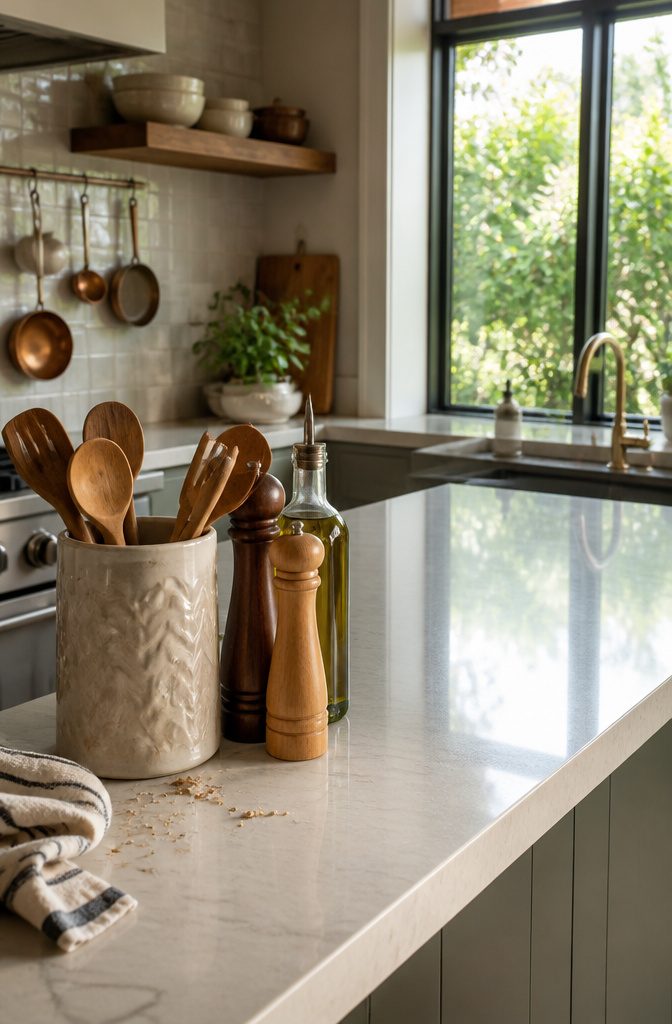
The objects you reach for every morning already belong on the island — they just need to look like you meant them to be there.
A utensil holder filled with wooden spoons and spatulas sits within arm’s reach while you cook, and if the vessel itself has weight to it, it reads as deliberate rather than leftover.
Williams Sonoma’s Famille Rose Porcelain Utensil Holder runs $79.95 and brings pattern without busy-ness; pair it with warm wood tones and it anchors one end of the workspace.
Salt and pepper mills earn the same treatment. Le Creuset’s pepper mill, $36.76, comes in their signature bold colors and sits next to a bottle of olive oil without looking like clutter.
If your island includes a sink, swap the plastic pump for something that matches the rest: a sleek glass dispenser for modern kitchens, ceramic for something warmer.
The SimpleHuman touchless soap dispenser solves the fingerprint problem and still looks clean on the counter.
6. Add Candles or Candleholders

Candles bring a soft, welcoming glow that makes a kitchen island feel less like a workstation and more like a place people want to gather.
I group vintage brass candlestick holders—usually under $10 each at thrift stores and flea markets—with other pieces on a tray or wooden board so they read as part of a larger arrangement rather than orphaned accessories.
A Wayfair hurricane set runs $45.99 if you prefer the contained look of glass, and you can swap in flameless versions if open flames near cooking make you nervous.
Pillar candles at different heights work well stacked alongside a bowl or a few books, and jar candles in fall tones like deep orange or brown fit seasonal displays without needing much adjustment when November rolls around.
Keep candles mobile: when counter space gets tight, you want decor that moves in seconds, not something anchored by weight or complexity.
7. Use Cookbooks, Books, or Magazines

A small stack of cookbooks brings color and height to the island surface, and unlike most decorative objects, you can pull one out and actually use it.
Choose books with interesting covers or spines that tie into the room’s palette, stack them flat with something small on top, or stand a few upright between bookends.
Vintage books work especially well if the kitchen already has warm wood or aged metal finishes.
Cookbooks also anchor a vignette when you layer them with other objects.
Set a ceramic bowl or a sculptural piece on top of the stack, or place a small pillar candle beside it for an evening look. Design magazines and home interior books serve the same purpose if cookbooks feel too literal.
Keep the stack low enough that it doesn’t block sightlines across the island, usually three to five books, and choose ones you genuinely reach for rather than treating them as pure decoration.
8. Display Wooden Boards, Platters, or Bowls

A wooden board adds warmth and texture without taking up much space. You can prop one against the backsplash or lay it flat and use it as a base for layering other pieces.
Wooden cutting boards and serving platters are easy to move when the island needs to double as workspace, which matters more than the styling itself.
A wood fruit bowl works the same way. Set it in the center empty for a simple everyday look, or fill it with produce or small decorative objects when you want a little more presence.
The Amazon wood fruit bowl at $42.99 sits low enough to stay out of the way, and the finish brings in the same warmth a cutting board does without adding fussy detail.
For something more custom, a personalized cutting board like the NakedWoodWorks version on Amazon at $24.99 gives the display a finished feel when propped upright.
Large ceramic or wooden bowls can anchor a corner of the island the same way. Either option keeps the surface usable while filling the space with something that looks intentional rather than leftover.
I’d skip anything too ornate or tall. Functional display, not a centerpiece that has to be cleared every time you need counter space.
9. Use a Pitcher, Vase, or Other Vessel

A vessel gives you room to play with use and emptiness at once.
A stoneware pitcher can hold fresh flowers, a bundle of wooden spoons and rolling pins, or smaller decorative objects like berries and sprigs, but it also works left completely empty if the design itself is bold enough to stand alone.
The Anthropologie Bistro Tile Stoneware Pitcher at $48.00 brings mosaic patterns and gold details that carry weight without anything inside.
A large vase filled with greenery adds height and softness without crowding the island, and if the surface is used often, keeping to one tall piece is enough.
A ceramic catch-all corrals cooking utensils so they stay handy rather than scattered, which reads cleaner than a single rolling pin left out on its own.
The approach works best when the vessel itself has presence: stoneware, crystal, or something with texture that earns the space it takes up.
10. Add a Cloth Layer, Such as a Runner, Towel, or Placemat

A runner, tea towel, or placemat softens the hard surfaces of an island and gives you a way to bring in color or pattern without committing to anything permanent.
A fabric runner can anchor a centerpiece or stand alone if the island is wood and you want to break up all that grain. The cloth also keeps smaller items from sliding around on a smooth countertop.
A folded tablecloth works as a runner if you don’t have one that fits, and it dresses up the space while adding a stripe of color next to the wood.
Cloth napkins layered into a display soften the edges of harder objects like a wooden cutting board or a crate full of utensils.
If you want something playful, a hand-printed tea towel draped over one end of the island adds personality—the Urban Outfitters sardine print runs $20.00 and works for a coastal kitchen.
The cloth layer is especially useful in farmhouse or seasonal setups, where it ties together objects that would otherwise float: anchor napkins with a small candle or wooden spoon, or use pastel-colored fabric in spring to lighten the whole arrangement.
The fabric keeps the island from reading as too utilitarian while still leaving room to work.
11. Build a Coordinated Theme, Collection, or Color Scheme

Repeated colors, materials, or objects pull a display together in a way that scattered pieces never will.
Group similar items by type, color, or material — hand-blown glass, ginger jars, blue-and-white ceramics — and the island reads as a deliberate choice rather than a drop zone for whatever was nearby.
The repetition does the work; the vessels themselves can be your collection, or they can hold one.
Color does the same job. A blue-and-white palette carried across bowls, a tray, and a vase ties the grouping to the rest of the kitchen without needing every piece to match exactly.
Texture adds depth without breaking the theme: wooden trays, patterned ceramic jars, glass vases, woven baskets.
Layer those textures inside a cohesive color scheme — complements to the existing palette, not fights against it — and the island gains warmth and personality at the same time.
Pops of color through towels, placemats, or cookware work the same way when the base stays coordinated.
12. Vary Height, Texture, and Shape

The grouping works when each piece brings a different visual quality instead of simply adding more.
A tall vase next to a low bowl breaks up the flatness, and placing the vase on a riser or cake stand lifts it further while creating space underneath for fruit or smaller objects.
The difference in elevation pulls the eye across the arrangement rather than letting everything sit at counter height.
Texture matters just as much. A vintage metal colander introduces contrast against wood cutting boards, and natural elements like branches or pinecones layer in roughness that smooth ceramics and glass lack.
Shape rounds out the mix: a wooden elephant figurine or a pitcher with a strong silhouette holds more visual weight than a plain canister.
The combination of height, material, and form gives a small grouping enough variety to feel composed without needing a dozen items crowding the counter.
13. Use Stools or Seating as Part of the Island’s Styling
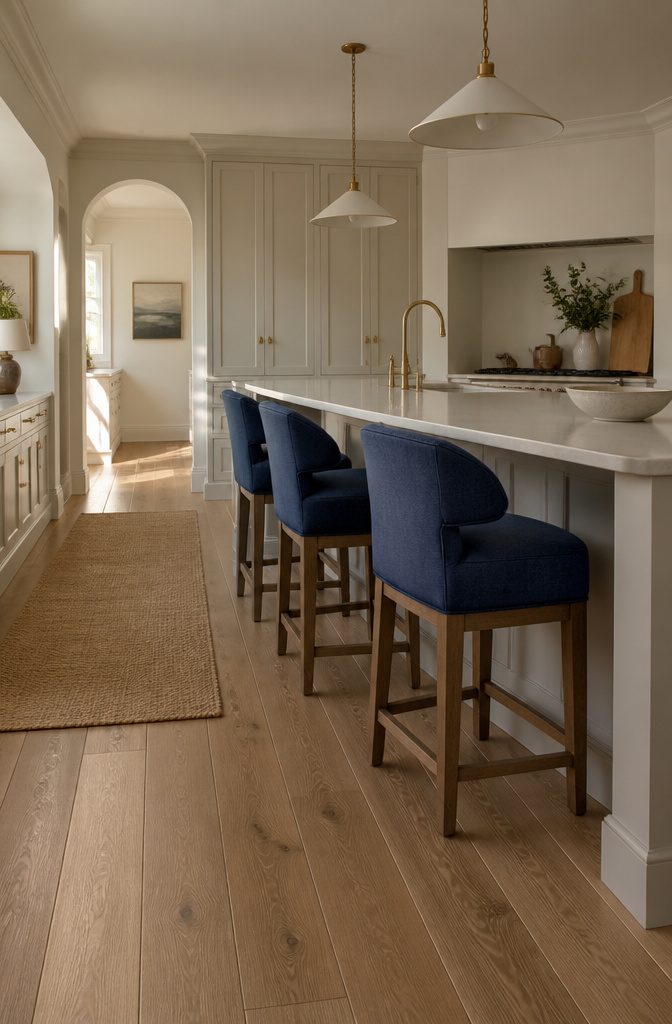
Stools and chairs carry more weight than most people give them.
Pick upholstered bar stools in a saturated color and a neutral island shifts from background piece to anchor. Flip it—put clean-lined stools in linen or black against bold cabinetry—and the island settles down without losing presence.
The Home Depot StyleWell Benfield biscuit upholstered stools at $169.00 show how a warm neutral holds its own without fighting pattern elsewhere in the room.
Seating also makes the island a place people actually use. Line up three or four stools and the counter becomes the spot for coffee before work or plating dinner while someone keeps you company.
Counter-height chairs with cushions work the same way if the island sits lower. Match the style to your cabinets and the whole setup reads as intentional, not assembled.
14. Use Lighting as Part of the Look

Pendants hung in a row above the island do two things at once: they add task lighting exactly where hands are busy and give the space a finished, deliberate look.
The Hampton Bay Talullah Pendant Lighting runs $49.97 and works well when you hang a few in sequence to define the island’s footprint. That repetition ties the look together without needing much else on the counter itself.
A table lamp brings something different. Set one at the corner of the island and the whole room shifts toward warmth and ambiance rather than pure utility.
The Anthropologie ceramic lamp at $138.60 pairs a bold printed shade with a glazed base, and that combination reads as personality rather than kitchen default.
Adjustable fixtures let you aim light where it matters, and adding a dimmer gives you control over mood depending on whether you’re prepping dinner or eating it.
Keep the Island Functional and Leave Room to Work

The island is where you chop, gather, and set things down, so leave most of it clear.
A vase or a small tray works when it sits to one side and you can slide it out of the way in five seconds.
Centering a large piece makes sense only if you move it every time you cook — and if that sounds annoying, it probably is.
Think about what happens on your island most days. If it’s meal prep, you need elbow room for a cutting board, a bowl, and ingredients spread out.
If people stand there with coffee or pull up stools for breakfast, keep the middle open so no one has to shift things just to set a mug down.
When decor fights for space with what you actually do, the decor loses.
Traffic matters too. If your island sits between the fridge and the stove, plan for four to four and a half feet of clearance around it so two people can pass without turning sideways.
An island that looks great but blocks the flow every time you reach for the oven becomes the thing you wish you’d sized differently.
How to Keep the Island from Looking Cluttered

The island stays clean when you keep displays to two or three pieces and give the rest of the surface room to work.
A tray or basket holds small items in one place and moves in one motion when you need counter space.
I use a shallow tray for salt, oil, and a small plant — it looks deliberate rather than scattered, and lifting it takes one hand.
Everyday clutter is the real problem. Mail, keys, and kitchen tools you rarely touch will colonize an island faster than anything you set there on purpose.
Those need a designated spot somewhere else, not tolerance on the counter. When the island is clear except for what you chose to display, the few pieces you left read as decor instead of leftovers.
Odd numbers look more finished than even.
Three small objects on a tray feel intentional; four of the same thing start to look like inventory. Varying height helps too, but that principle belongs to arrangement — this section is about limiting what lands there in the first place.
Leave empty space. The island should breathe.
Change a Few Elements Seasonally
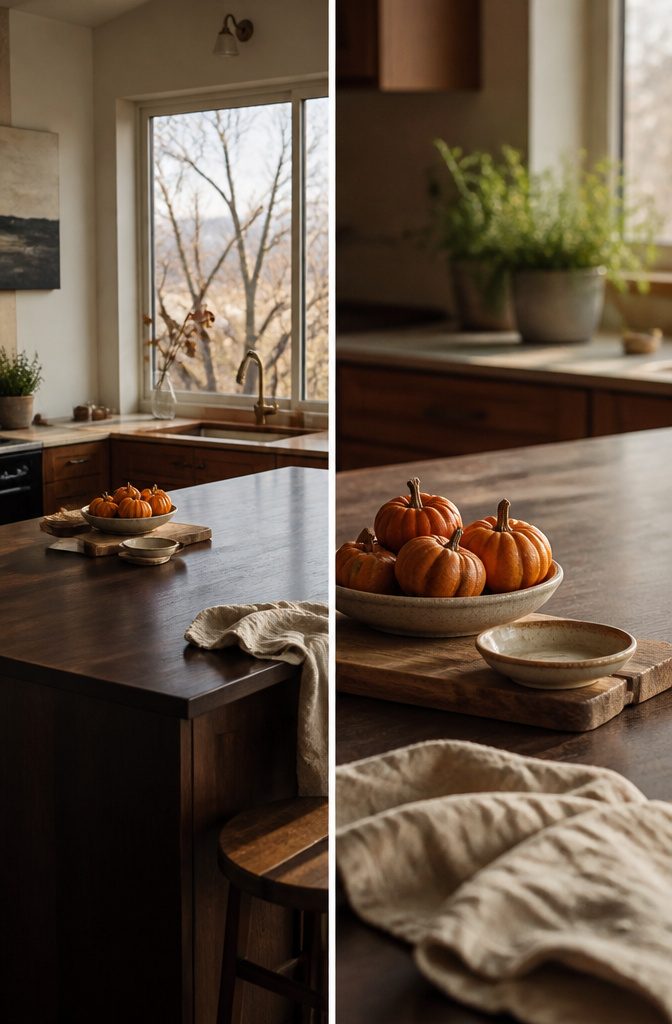
Keeping a few pieces constant and swapping just one or two seasonal elements prevents the island from feeling overdone every few months.
When fall arrives, that might mean replacing summer citrus with a bowl of small pumpkins or switching tulips for branches clipped from the yard.
In winter, swap the branches for evergreen sprigs or a single ornament tucked into a bowl of pinecones. The tray stays, the cutting board stays, and the change registers without demanding a full reset.
Spring and summer lean on what grows: fresh flowers in the same pitcher you used all year, a bowl of lemons instead of apples, or a potted herb that sits on the island until the season turns.
The base arrangement holds its place, and the few rotated pieces keep the kitchen tied to what is happening outside the window.
Small updates work better than redecorating from scratch, and they take less than ten minutes when the season shifts.
Frequently Asked Questions
How do I keep my kitchen island from looking cluttered?
Stick to 2 or 3 pieces and leave the rest of the surface open for work.
A tray or basket corrals small items so they lift away in one motion when you need counter space. Odd numbers look more finished than even, and empty space keeps the island from reading as crowded.
What should I put on a kitchen island?
Choose items that are both useful and attractive: a tray, a bowl of fruit, a vase with flowers, or a utensil holder. 2 or 3 pieces are enough to make the island look finished without taking over the workspace.
How do I decorate a kitchen island simply?
Start with 2 or 3 items that serve a purpose, like a wooden board, a bowl, or a small vase. Keep the grouping tight and leave most of the counter clear so the island stays functional.
What is the best centerpiece for a kitchen island?
Pick something that fits how you use the space: a bowl of fruit if the island sees heavy use, flowers or greenery for height and color, or a tray of everyday items that you can move fast.
The best centerpiece is one that works with your routine, not against it.
Should a kitchen island be decorated or kept clear?
Use a few simple items but leave room for everyday tasks.
The island is where you chop, gather, and set things down, so most of it should stay open. A vase or small tray works when it sits to one side and moves out of the way in seconds.
What looks good on a kitchen island?
Useful objects like a fruit bowl, salt and pepper mills, a pitcher, or a utensil holder look intentional and earn their place. If the piece serves no purpose, it becomes something you shift every time you cook.
How do you style a small kitchen island?
Use 1 or 2 simple pieces and preserve room for meal prep and groceries. A compact arrangement like a small plant or a tray with a candle fits without crowding the surface.
What should I put in the middle of my kitchen island?
A large bowl, a tall vase with greenery, or a tray with a few grouped items all work as a single focal point.
The middle is also where you need the most working room, so whatever sits there should move fast when you start cooking.