
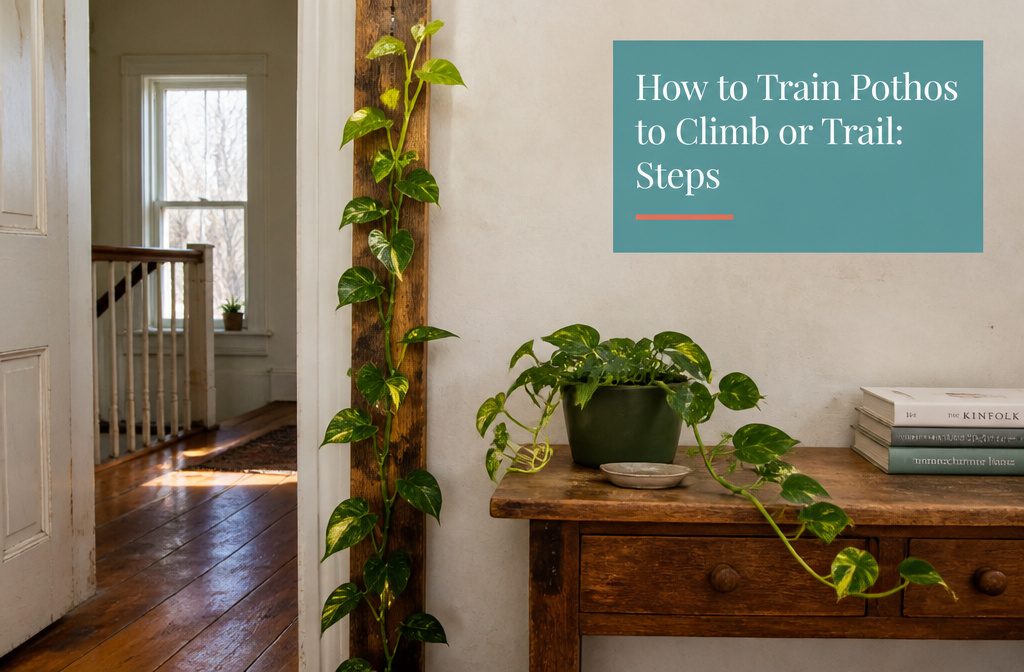
Training pothos to climb turns 4-inch leaves into 12-inch ones, but only if you position aerial roots against the support and give the top of the vine enough light to keep reaching.
Most people guide the vines into place and then wonder why the plant won’t grip: the side of the stem carrying the roots has to face whatever it’s climbing, not hang away from it.
1. Decide Whether You Want Your Pothos to Climb or Trail

Pothos can grow in either direction, and the choice changes what the plant looks like.
In nature, pothos climb trees using aerial roots that latch onto bark, sometimes reaching 60 feet. Indoors, trailing is what happens when you do nothing: vines spill over the edge of a pot and keep going, leaves staying 3 to 6 inches.
Climbing requires a support and a little effort, but it turns on a developmental response. Leaves grow progressively larger as the plant moves upward, from around 4 inches early on to 12 inches or more once the vine matures.
The decision depends on the space you have and the look you want.
Trailing needs vertical drop space below the pot and gives you long cascading vines. Climbing needs height above the pot and produces bigger, more dramatic foliage that reads as a feature plant rather than a shelf accent.
You can also split the difference: train some vines up a support and let others trail from the same pot.
2. Pick a Support That Fits Your Space
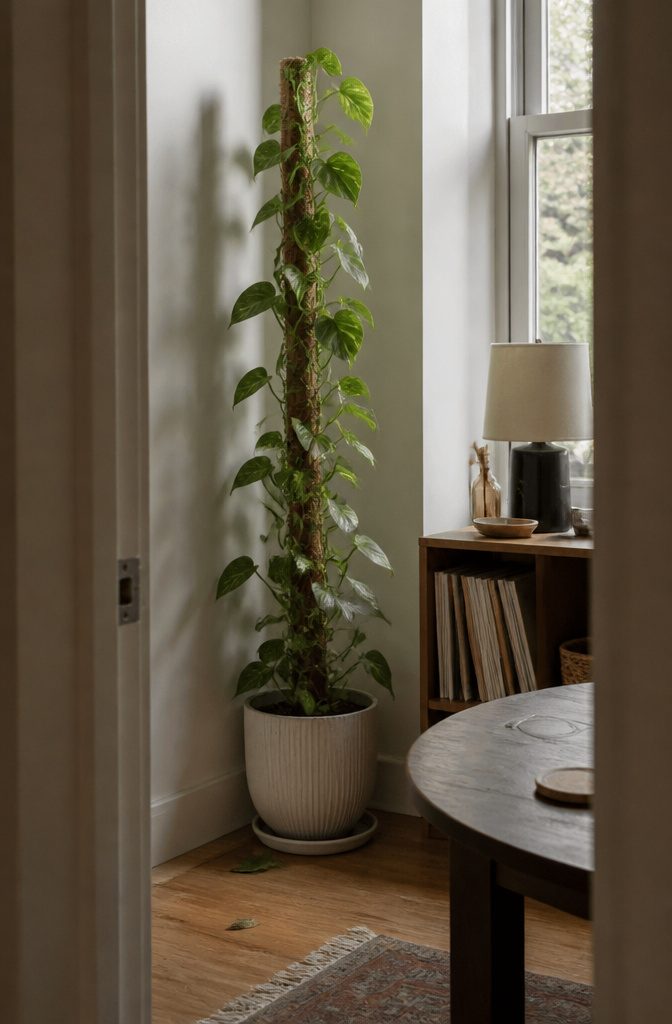
A moss pole or coco coir pole gives the aerial roots something to latch onto, but pothos does not require a moss pole simply to grow upward.
Trellises, bamboo stakes, wire shelving, 3M command hooks, picture frame hooks, and wire all work.
The Blooming Jungle Store’s Coco Coir Moss Poles fit mid-size pots; Mosser Lee Totem Pole Moss Pole comes in 24 inches. LeoBro’s Plant Cages keep the vines contained if you want a bushier shape without height.
Matching the support to the room matters more than the material.
A moss or wooden pole stuck in the center of the planter keeps the plant bushy and tall, good for a corner or a tabletop where floor space is tight.
Wall hooks and wire let you spread the vines horizontally or send them up one side of a bookcase. Plant cages work when you want the pothos to fill out rather than trail across furniture.
3. Wait Until the Plant Is Healthy and Growing

Training works best once the plant is stable and putting out new growth. I avoid positioning stems right after heavy repotting disturbance—let the plant settle first until it looks comfortable in the pot and the stems are extending.
If the support went in during repotting and the roots were barely touched, stems can often be positioned straight away as long as nothing is being pulled.
Spring and summer growth is easier to train because new stems flex more willingly and the plant is already lengthening on its own, but there is no required vine length to wait for.
Start once a healthy stem reaches the support without being bent or stretched.
Adequate light drives that growth. A pothos within 4–6 feet of a window gets enough brightness to keep vines moving; closer to an east-facing window gives morning light without harsh afternoon sun.
If the window faces west or south, keep the plant at least 8–10 inches back to avoid leaf scorch.
Temperatures between 65 and 80°F suit pothos best, and well-draining soil—something like a 2:1:1:1 mix of peat moss, bark chips, perlite and coarse sand—keeps roots healthy without holding too much water. Outdoors, pothos grows year-round in USDA Zones 10 to 12.
4. Guide the Vine Toward the Support in Its Natural Direction

Position each vine by following the natural curve of the stem rather than forcing it into place.
Stems snap easily when bent too sharply or twisted at angles they don’t want to take, so I lift the tip gently and guide it toward the support without redirecting the whole length at once.
Older vines that have stiffened need more patience.
Rather than bending a rigid stem sharply around a pole or hook in one motion, I redirect it gradually over a few days, anchoring one section at a time from the base upward.
New growth stays flexible and takes direction more readily, but there is no required vine length before you can begin—start once a stem is long enough to reach the support without being pulled taut.
If a vine does snap while you’re guiding it, the broken piece roots easily as a cutting. The plant will send out new vines to replace it.
5. Attach the Stem Loosely With Soft Ties or Clips
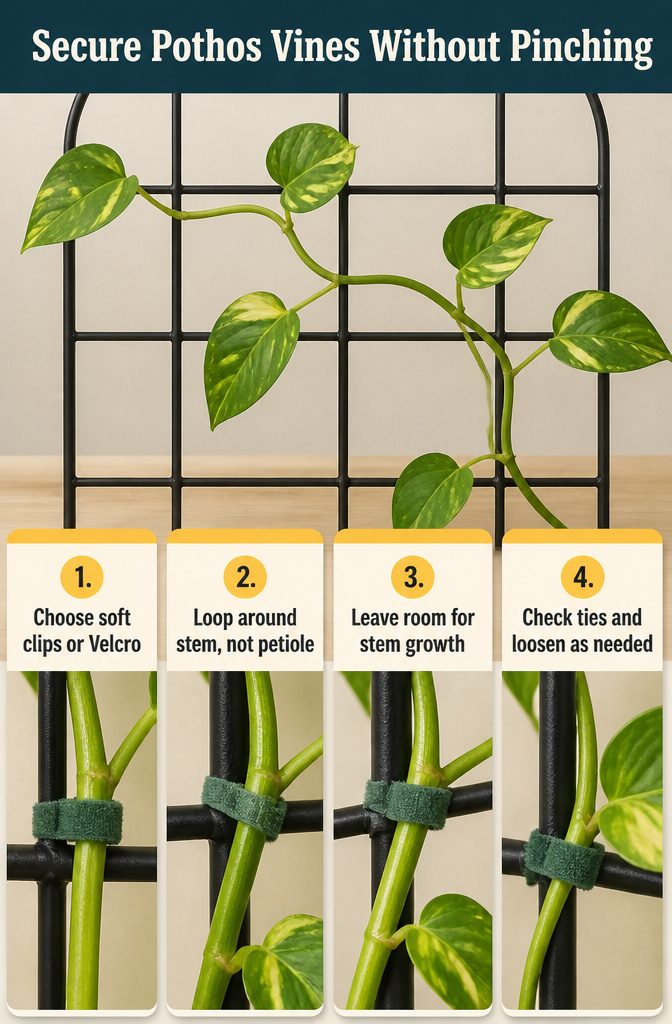
I secure each vine with soft plant clips or Velcro strips spaced just often enough to hold it against the support—there’s no need to attach every node or follow exact three-inch intervals.
The tie goes around the stem itself, never around a leaf or petiole where it can damage new growth.
I keep each attachment loose enough that the stem can thicken without being pinched or indented, which means checking back every few weeks as the plant grows and loosening anything that’s starting to dig in.
If the vine won’t grip the support on its own at first, I’ll use a light string to hold it in place temporarily, especially on smooth metal trellises where aerial roots have nothing to latch onto right away.
The stems are flexible and easy to position, but they’ll snap if bent too sharply—if that happens, the broken piece roots easily as a cutting.
As each vine extends, I add new clips ahead of the growing tip rather than trying to redirect older stems that have already set their direction. Pruning shears run around $6 for trimming wayward growth.
6. Position Aerial Roots Against the Support
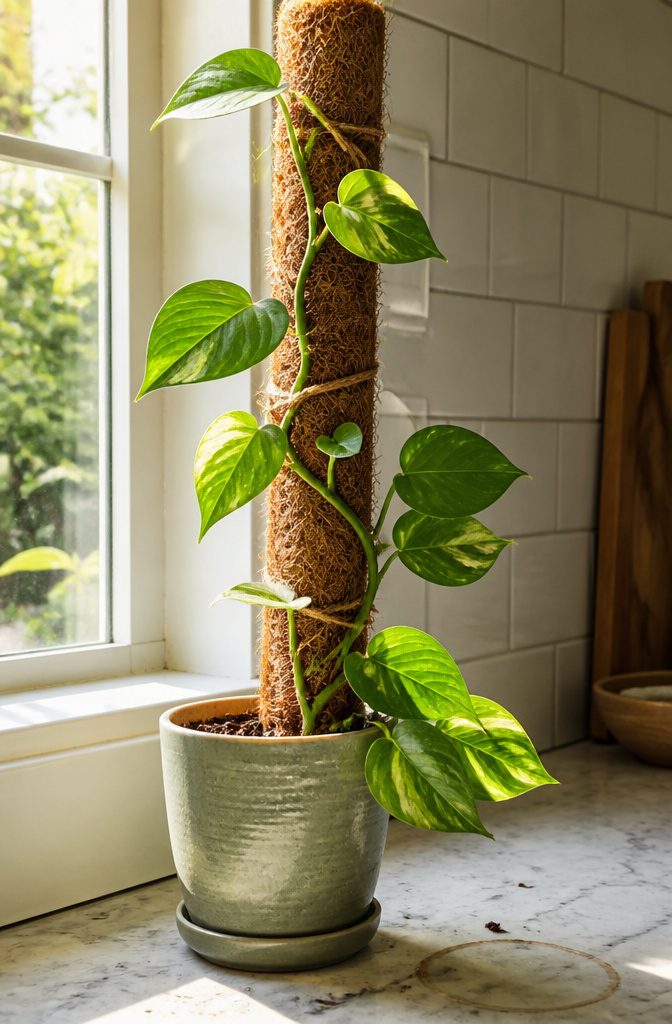
Aerial roots are what let pothos grip a support, so the side of the stem carrying roots needs to face whatever it is climbing.
Look along the vine and you will see small brownish nubs or short projections extending from nodes; those are the roots.
When you position the stem against a moss pole, coir stick or textured trellis, place it so the roots make contact with the surface. The plant then attaches itself over time.
Loose ties or clips hold the stem in place while the roots grow into the support material.
NC State and the Royal Horticultural Society both recommend supports that allow the roots to reach and anchor rather than binding the stem tightly away from contact.
A moss pole works well because the roots can push into the damp fiber.
Wood, coir and rough bark give enough texture for the roots to latch on. Once attachment begins, the plant relies less on the clips you started with.
7. Add Clips Ahead of New Growth Rather Than Redirecting Old Stems

New growth bends where old stems resist. I place clips or ties where the newest vines are heading rather than forcing established portions into sharp turns.
Older stems stiffen after a few months, and bending them back on themselves risks a snap; younger growth at the tip stays flexible enough to guide onto a pole or through a trellis without damage.
I add support ahead of the vine rather than catching up after it has already changed direction.
Pothos grows 6–12 inches per month during the growing season, and vines can cascade 3–4 feet within a single growing season, so a clip placed today sits two feet behind the tip by midsummer.
Spacing clips every 8 to 10 inches keeps pace with that rate without leaving long unsupported sections that sag or twist away from the intended path.
8. Give the Upper Growth Enough Light

Adequate light at the top of the support keeps upper leaves healthy and pushes the vine to keep climbing.
If the top of a tall pole grows into a dark corner, the vine stretches thin even when the lower part looks fine.
Position the whole setup within 4–6 feet of a window so the climbing portion continues receiving useful light. An east-facing window gives morning brightness without harsh afternoon sun.
Rotating the pot every week or two promotes even growth and prevents the vine from leaning heavily toward the light source. Insufficient light slows growth, produces small leaves spaced far apart, and creates leggy stems.
Direct sun, on the other hand, can scorch leaves and cause yellowing. A support alone will not create a lush climbing plant; light and structure work together to produce the larger, progressively mature leaves that climbing encourages.
9. Prune to Shape and Encourage Fullness
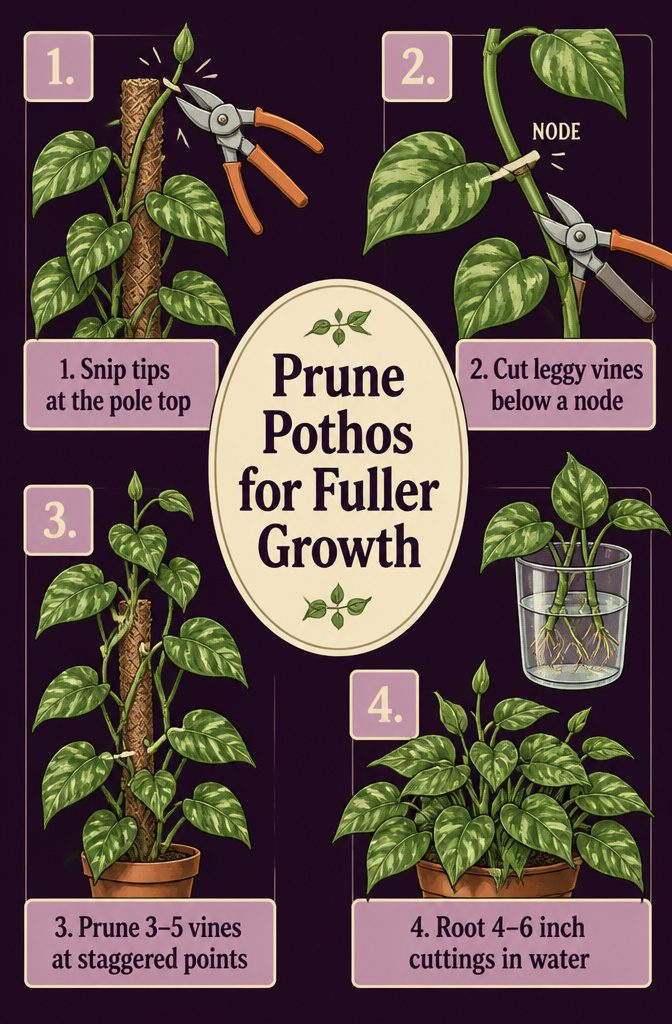
Pruning controls how long the vines get and how full the plant looks at the base. Once vines reach the top of a pole, snip the tips off.
That stops the growing point and signals the plant to branch out instead of just climbing farther. The result is larger leaves and denser foliage that eventually covers the support.
Cut long or leggy vines straight across just below a node—the bump where a leaf attaches. The vine does not regrow from the cut; instead, the next node below sprouts a new growth tip.
I prune 3–5 vines at staggered points, and the plant fills out within 2–3 weeks. Tip pruning once a year is enough to keep most pothos looking full, though faster growers may need it two or three times.
The cuttings do not go to waste.
A 4–6 inch piece with 2–3 nodes placed in water develops roots in 2–3 weeks, with the first roots visible in 7–10 days. Pot several rooted cuttings back into the mother plant if there is room, and the top looks thick again.
10. Move the Support With the Plant When Repotting

When the roots start circling the pot or nudging out the drainage holes, it’s time to move up a size. Move the entire trellis with the plant rather than trying to untangle the vines.
By the time repotting comes around, the roots have usually wound themselves around the base of the pole to anchor it, and the vines have locked onto every rung or wrapped the moss.
Pulling them apart risks snapping stems or tearing aerial roots that have fused to the support.
Lift the whole assembly—root ball, pole and vines together—and set it in the new pot at the same depth.
Hold the trellis upright while backfilling with fresh potting mix. Most growers repot pothos every one or two years to give the roots room and refresh the soil, though some wait as long as five years between moves.
If the vine has outgrown the height of the pole, swap in a taller one now or add an extension so new growth has somewhere to climb.
Light Decides Whether Pothos Climbs or Hangs

Pothos vines trail horizontally or hang downward unless bright indirect light sits above them and gives them a reason to climb.
In the wild, these plants grow upward from the rainforest floor toward the canopy, wrapping around tree trunks as they reach for more light.
Indoors, the same response works in your favor: place the plant under a skylight, a tall window, or a grow light hung above it, and the vines will stretch toward that light source rather than spilling over the pot’s edge.
Without light overhead, pothos has no incentive to climb a wall or trellis, no matter how sturdy the support.
Varieties with heavier variegation need brighter conditions to keep their markings and maintain upward growth.
Marble Queen and NJoy both lose color and slow down when light levels drop, so if you’re training one of those up a moss pole or wall grid, check that the upper end of the support gets enough brightness to pull the vine along.
Climbing Produces Larger Leaves Than Trailing

Pothos leaves can grow from 4 inches to 12 inches or more as the plant matures upward on a support, compared to typical trailing leaf sizes of 3–6 inches.
Golden Pothos leaves stay around 4–6 inches when trailing, Marble Queen around 4–5 inches, and Neon Pothos around 3–5 inches.
Cebu Blue falls into a similar range. The difference is dramatic enough to change the whole look of the plant.
If you want big, impressive leaves, climbing wins. If you want cascading, flowing vines, trailing is the way to go.
Higher humidity also pushes leaf size larger.
At 60% or above, leaves develop more fully than they do at average household humidity of 40–50%. Combining a moss pole with consistent moisture in the air gives you the best chance at those jungle-sized leaves indoors.
Water and Feed During Active Growth

Water when the top 1–2 inches of soil feel dry. In winter that might be every nine to fourteen days; during active growth in spring and summer, you’ll water more often.
Keep the soil consistently moist but not waterlogged. Chronic underwatering slows vine growth and causes leaves to curl; overwatering brings yellowing and root rot.
A pot with drainage holes is non-negotiable, and if the pot sits in a saucer, empty it after watering so the plant isn’t left standing in water.
Feed every two to four weeks during spring and summer with a balanced liquid fertilizer at half strength.
I alternate between Maxsea, Sea Grow, Grow Big, and Liquid Kelp through the growing season. Espoma Organic Indoor Plant Food works well, too.
Nitrogen drives leafy vine growth, but fertilizer helps only if light is already sufficient. Fertilizing a pothos in low light pushes weak, leggy growth rather than healthy vines.
Move the plant to better light first, then feed. Skip fertilizer in late fall and winter when growth naturally slows.
Varieties That Trail Well

Not all pothos varieties trail with the same speed or visual weight. If you want a long cascade, match the variety to the light you have and the look you’re after.
The four that perform best in trailing displays:
- Golden Pothos grows fast, tolerates low to bright indirect light, and produces 4–6 inch leaves on vines that can reach 13 feet long indoors. The most forgiving option if light is limited.
- Marble Queen grows more slowly due to high variegation but delivers striking white-and-green contrast. Leaves run 4–5 inches, and it needs bright indirect light to compensate for reduced chlorophyll.
- Neon Pothos grows quickly with electric chartreuse leaves 3–5 inches long. Vines reach around 8 feet. Best in bright rooms where the color can show.
- Cebu Blue has narrow, silvery-blue leaves that shimmer in good light and trail more loosely than the others, giving an airy look in hanging baskets.
Well-cared-for specimens in bright rooms have been documented trailing 20+ feet, though most indoor vines settle around 10 feet or more. You can buy pothos in 4, 6, 8, and 10 inch grow pots.
Remove Nursery Pins and Let Vines Hang Freely

Most potted pothos arrive with their vines pinned, clipped, or wrapped around a stake to fit the nursery shelf, and none of those supports belong in your setup.
Pull out every pin and clip before you decide where the plant goes. The vines will hang freely once you release them, and gravity will pull them into the direction they naturally want to grow.
Hanging the pot gives the vines unrestricted downward room and can improve light exposure if you place it near a window, but it does not speed up growth on its own.
What it does do is let the plant show off a full cascade without furniture or a sill getting in the way.
One thing to plan for: a large pothos in a plastic nursery pot, fully watered, can weigh 5–7 pounds. That weight decides which hook and bracket you need, so check the rating before you hang anything.
New Leaves Will Not Fill Bare Spots on Old Stems

Pruning a long vine can trigger new shoots from dormant nodes nearby, but new leaves will not grow back in the exact bare spots where old foliage dropped.
The stem remembers where it lost a leaf, and that spot stays empty even after you cut the end.
If low light or inconsistent watering stripped the lower half of a vine, moving the plant to brighter indirect light and trimming the leggy ends may coax out fresh growth a few nodes down, yet the original gap remains.
The faster fix is rooting cuttings and planting them back into the same pot.
A 4–6 inch cutting with 2–3 nodes will root in water within 2–3 weeks, and several of those tucked into the crown fill out the top where trailing plants often look thinnest.
I lean on this method whenever an old pothos has healthy ends but a bare base that pruning alone will not rebuild.
Frequently Asked Questions
Do pothos like to climb or hang?
Pothos can do both.
They trail naturally when left alone, producing 3–6 inch leaves on cascading vines. Give them a support and bright light above, and they climb instead, growing progressively larger leaves up to 12 inches or more as the vine matures upward.
Can pothos grow upward?
Yes. Pothos vines grow upward toward light when given a support to attach to, just as they climb trees in their native habitat.
Position the plant under a skylight, tall window, or grow light hung above it to encourage vertical growth rather than trailing.
Can you make the spacing of leaves on pothos stems closer?
No. New leaves will not grow back in the exact bare spots where old foliage dropped.
Pruning leggy vines may trigger new shoots from dormant nodes nearby, but the original gaps remain. Rooting cuttings and planting them back into the pot fills out thin areas faster.
Are some pothos varieties harder to care for than others?
Varieties with heavy variegation like Marble Queen and NJoy need brighter indirect light to keep their markings and maintain healthy growth. Golden Pothos tolerates low to bright light and is the most forgiving if light is limited.
Can I put the stem cuttings back in with the mother plant?
Yes, if there is room in the pot.
A 4–6 inch cutting with 2–3 nodes roots in water within 2–3 weeks. Several rooted cuttings planted back into the crown fill out the top where trailing plants often look thinnest.
How long can pothos vines grow indoors?
Most indoor pothos vines settle around 10 feet or more, though well-cared-for specimens in bright rooms have been documented trailing 20+ feet. Vines can cascade 3–4 feet within a single growing season during active growth.
Can I make a short pothos trail faster by adding fertilizer?
Fertilizer helps only if light is already sufficient.
Feeding a pothos in low light pushes weak, leggy growth rather than healthy vines. Move the plant to better light first, then feed every 2–4 weeks during spring and summer with balanced liquid fertilizer at half strength.
Should I remove the nursery pot pins holding vines in place?
Yes. Pull out every pin, clip, and stake before deciding where the plant goes.
Those supports exist only to fit the plant on a nursery shelf. The vines will hang freely once released, and gravity will pull them into their natural direction.
Does hanging the pot help the pothos grow faster?
Hanging gives vines unrestricted downward room and can improve light exposure if placed near a window, but it does not speed up growth on its own.
What it does do is let the plant show off a full cascade without furniture or a sill getting in the way.
What makes a pothos happy?
Bright indirect light within 4–6 feet of a window, consistent moisture when the top 1–2 inches of soil feel dry, and temperatures between 65 and 80°F keep pothos healthy.
Well-draining soil and a pot with drainage holes prevent root rot, and feeding every 2–4 weeks during spring and summer supports active growth.