I’ve installed hardwood in three homes, and I’ll cut to the chase: you’re looking at $7–$25 per square foot installed. Engineered wood with click-lock floating runs cheaper, while solid hardwood with nail-down labor plus subfloor prep, especially if they’re ripping up some ancient 1970s subfloor, hits that painful top tier fast.
Hickory costs more than Maple, Maple beats Red Oak, and herringbone patterns add $8–$12 more per square foot just for the installation complexity and alignment work.
Factory-finished planks save you finishing labor and last longer, but site-finished gives you that custom stain match your heart wants. Buy 10–15% extra for waste, future repairs, and the inevitable moment when your dog scratches the good stuff.
Big-box stores dangle lower sticker prices, but local dealers often bundle installation, warranties, and guidance that prevents expensive mistakes.
Get quotes with your exact square footage, zip code, and every cost broken down: materials, labor, prep, and all additional charges, or prepare for surprises that’ll strain your budget.
Species comparisons, hidden fees, and negotiation strategies require attention if you want to avoid overpaying.
What Hardwood Flooring Actually Costs in 2026
Why does hardwood flooring pricing feel like a moving target? I’ve been staring at quotes that swing wildly from $6 to $25 per square foot, wondering if I’m getting played or just confused.
In 2026, engineered hardwood typically runs $7–$20 installed, while solid hardwood pushes $10–$25. Material costs alone split at $4–$12 versus $5–$15 per square foot, and labor costs tack on another $3–$8 or $5–$10 depending on your pick. The national average hovers around $13–$17, but your actual bill depends on subfloor prep (add $1–$4) and tearing out that 1970s nightmare underneath ($1.50–$4.50 more).
Budget planning requires accounting for these variables upfront to avoid surprise costs down the line.
Solid vs. Engineered Hardwood: Which Costs More Per Square Foot?
I kept circling back to those numbers, and one question kept nagging me: solid or engineered, which one’s actually gonna hit my wallet harder?
Here’s the real deal: solid hardwood runs $5–$15 per square foot for materials, while engineered hardwood clocks in at $4–$12. Installation labor flips the script even further. Solid needs nail-down work, subfloor prep, the whole nine yards, pushing your total to $10–$25 per square foot. Engineered offers click-lock installation at $7–$20 total and can be installed over imperfect subfloors.
Sure, fancy solid can creep up on engineered prices, but engineered typically costs less overall. The moisture stability in bathrooms and basements makes engineered the practical choice for moisture-prone spaces.
Prefinished vs. Site-Finished: What’s the Price Difference?
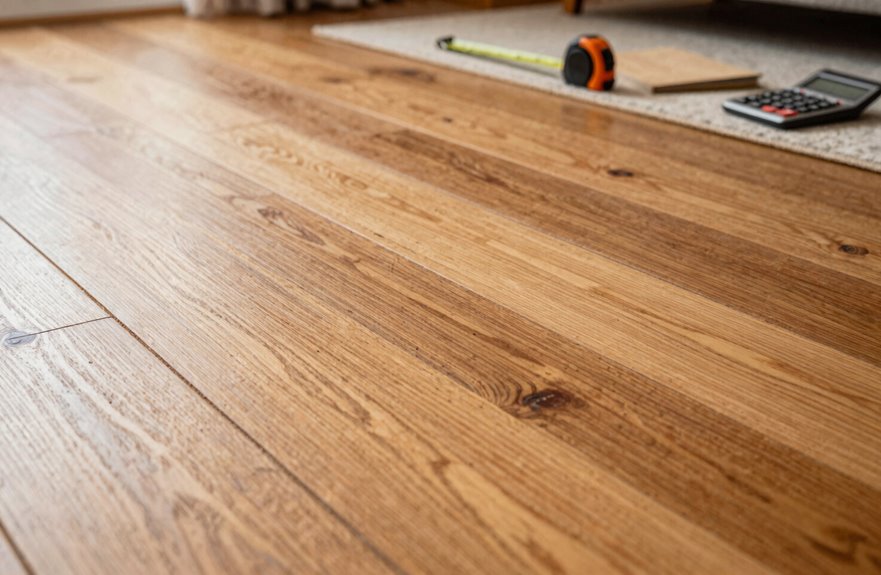
I’m breaking down the real numbers between prefinished and site-finished hardwood, because that glossy factory finish isn’t just pretty—it’s your ticket to skipping the sanding circus entirely. You’ll pay roughly $2 to $8 extra per square foot for on-site finishing, which pushes solid hardwood toward that $25 ceiling, while prefinished engineered options like UV-cured finishes get you walking on floors faster than a DIY project would allow. The upfront cost difference is only part of the equation. Consider the decades of refinishing potential ahead. A factory finish protects against wear patterns and maintains durability far longer than site-finished floors, which means fewer refinishing cycles and lower maintenance costs over thirty years.
Material Cost Comparison
Where do we even begin when prefinished and site-finished hardwood come with such different pricing structures? Let me break this down.
Material costs for solid hardwood hit $5–$15 per square foot, while engineered hardwood runs $4–$12. This represents immediate savings. Prefinished planks arrive ready to install, so you’re paying strictly for the boards themselves. Site-finished means buying unfinished planks plus every drop of stain, sealer, and labor that follows.
The budget difference becomes clear: prefinished engineered hardwood installations typically land at $7–$20 per square foot total, solid hardwood at $10–$25. That factory coating, aluminum oxide and UV-cured, eliminates on-site finishing crew expenses. The prefinished option simplifies cost calculations compared to site-finished alternatives.
Labor and Time Savings
Several days of my life I’ll never get back. That’s what site-finished flooring cost me last spring, and I’m still sweeping sawdust out of my truck. Prefabricated finishes changed everything for my kitchen reno. Engineered planks arrived ready to roll with no sanding marathon and no stain fumes waking me up at 3 AM. Installation took one Saturday instead of a chaotic week. Labor costs were significantly lower. We’re talking $6–$20 per square foot for engineered prefinished versus $10–$25 for solid site-finished once you factor in those extra finishing days. Sure, premium wear layers increase material prices, but the ability to walk on my floors immediately makes that trade-off worthwhile. I saved substantial time and money by avoiding extended project timelines, and I no longer need to treat my living room as a construction zone.
Long-Term Value Analysis
Why does my wallet still hurt years later? Because I didn’t crunch the real numbers on prefinished versus site-finished. Prefabricated (prefinished) floors hit your budget upfront, sure, but that factory finish lasts for decades with minimal maintenance and no sanding dust in your coffee.
Site-finished solid hardwood lets me customize that perfect honey-walnut tone, matching my grandma’s sideboard exactly. But the labor costs pile up. Sanding, staining, sealing, and curing time add significant expense. Site-finished typically costs $6 to $25 per square foot, usually landing at the pricier end.
Engineered hardwood performs better in tricky basements where moisture is a concern, narrowing the cost gap between prefinished and site-finished options. Prefinished floors reduce installation headaches and timeline delays. Site-finished floors provide greater color and finish customization. Your choice depends on whether you prioritize budget efficiency or design control.
Does Nail-Down or Floating Installation Cost More?
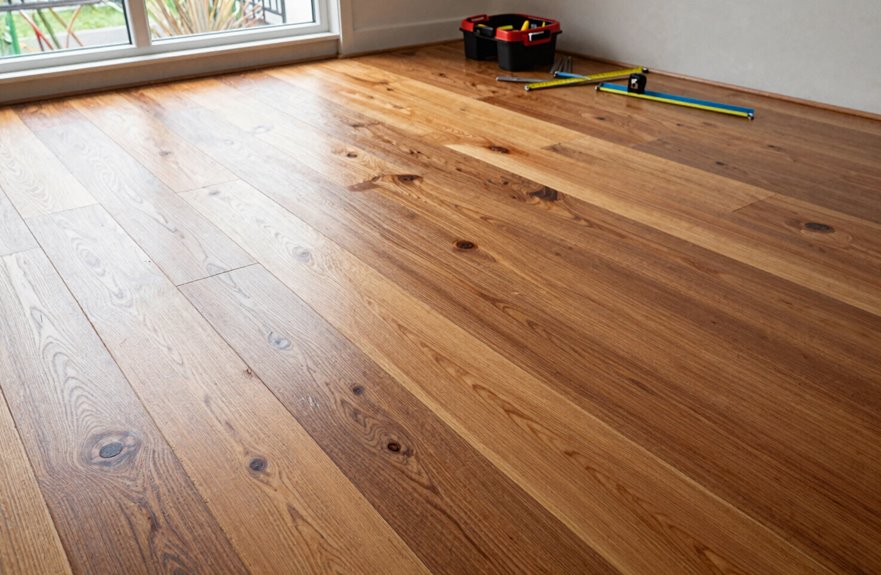
I’ve learned the hard way that nail-down installation will hit your wallet harder than floating methods, since every single board needs hand-nailing into a perfectly prepped subfloor. Think of it as the difference between assembling IKEA furniture versus hand-crafting a cabinet. Floating floors, especially those click-together engineered options, practically snap into place. There’s some tapping involved, but still, you’ll see labor quotes around $3–$8 per square foot instead of that $5–$10 nail-down cost. When you’re budgeting, remember that herringbone patterns and old carpet removal will stack extra costs onto either method, though nail-down prep work, including leveling and moisture barriers, tends to balloon fastest.
Nail-Down Labor Intensity
How much sweat goes into installation? Nail-down installation demands serious labor intensity. Solid hardwood requires pounding each plank into place, which means more time, more skill, and increased cost.
Here’s the breakdown:
| Factor | Cost Impact | What You’re Signing Up For |
|---|---|---|
| Basic nail-down labor | $5–$10/sq ft | Physical endurance required |
| Subfloor prep (when needed) | +$1–$4/sq ft | Leveling, patching, praying |
| Herringbone/chevron patterns | +$8–$12+/sq ft | Gorgeous, but labor-intensive |
| On-site sanding/finishing | +$2–$8/sq ft | Dust everywhere, worth it? |
Skip the subfloor prep homework and you’ll pay later. Complex layouts, stairs, irregular rooms push costs toward $10–$25+/sq ft. Solid hardwood underfoot delivers lasting value.
Floating Installation Simplicity
Floating installation feels like a breeze of newness after all that hammering. Watching those engineered hardwood planks click together without a single nail is almost therapeutic. The labor costs are significantly friendlier to your wallet, usually $3 to $8 per square foot versus nail-down’s $5 to $10. I learned this the hard way after my first flooring disaster (let’s not talk about the warped planks in my kitchen). Floating installation skips all that specialized fastening, so crews finish faster, you pay less, and the process becomes more efficient. For engineered hardwood especially, this method makes sense with less prep, fewer moisture headaches, and more money left for that vintage rug you’ve been eyeing. Choosing floating installation means avoiding the complications and extra expenses associated with traditional nail-down methods.
Cost Comparison Overview
So which installation method actually empties your wallet faster? The numbers show that nail-down costs more. We’re talking $10–$25 per square foot for solid hardwood flooring, while engineered hardwood floating floors run $7–$20. That gap matters.
Nail-down installation costs more because it requires precise nailing, subfloor prep, and pattern alignment. These are labor-intensive processes. Floating click-lock installation is more forgiving. Contractors can install engineered planks more quickly than nail-down systems, which require careful attention to each board.
Complex patterns like herringbone add $8–$12 or more per square foot. Nail-down installation suffers more cost increases because alignment precision is critical. Subfloor issues affect both methods, but solid nail-down demands perfection, which increases labor costs.
If you’re budget-conscious, engineered hardwood with floating installation reduces costs significantly while providing the warm, authentic appearance of traditional hardwood.
Oak, Maple, or Hickory: Which Wood Species Costs Most?

When you’re staring at those wood samples under harsh showroom lights, wondering which species will drain your wallet fastest, the price differences become clear quickly.
Red Oak usually hits that sweet spot, running $5–$15 per sq ft, which makes it the budget-friendly champion of this trio. Maple climbs higher, landing around $6.50–$11.00 per sq ft, with that pale, sleek look commanding respect and dollars. But Hickory is your wallet’s nemesis. Its wild grain and rock-hard density push it past both. So if we’re ranking by price, Hickory takes the crown, Maple sits in the middle, and Red Oak keeps your bank account manageable.
How Much Extra Flooring to Buy: Waste, Overages, and Accessories
Why do I always end up with three extra boxes of flooring stuffed in my garage like some kind of wood-hoarding dragon. Because one painful project taught me exactly how much overage prevents costly mistakes.
I order 10% to 15% extra materials for waste, cuts, defects, and future repairs when my dog inevitably scratches the hallway. For my 129 square foot bedroom, that overage bumped my total from $814 to over $1,072. Real numbers that stung until I remembered matching dye lots disappear forever.
Herringbone patterns devour extra planks. Subfloor prep surprises demand more waste allowance. Accessories matter too; transition strips, underlayment, and those tiny details complete the look.
That extra wood prevents expensive callbacks when you need matching materials months or years later.
What Hidden Costs Surprise Hardwood Flooring Buyers?
How exactly did my “simple” flooring project balloon from a $3,000 budget to nearly six grand? Hidden costs, that’s how. Installation isn’t just slapping down pretty planks.
First, my subfloor was a disaster. It was uneven, squeaky, and needed prep work that added $3 per square foot. Then I chose a herringbone pattern, which added $10 per square foot to installation costs.
Finishing choices matter too. Site-finished floors offer beauty, but that’s another $5 per square foot for sanding, staining, and sealing. Factory-finished floors save labor costs but limit your custom options.
Don’t forget removing old flooring, which runs another $2-4 per square foot.
Budget extra for these expenses. The initial cost estimate rarely accounts for subfloor preparation, pattern complexity, finishing methods, and demolition work.
Do Big-Box Stores or Local Dealers Offer Better Prices?
Where exactly should I hand over my credit card for hardwood flooring: those giant warehouse stores with their endless aisles, or the cozy local shop where they actually remember my name? I’ve compared both options by visiting fluorescent-lit warehouses and sitting down with local dealers who sketched room layouts on napkins.
On material cost, big-box stores offer lower sticker prices. Engineered hardwood runs $4–$8/ft², solid hardwood around $5–$10/ft². However, cheaper materials often lead to costly installation problems. Local dealers typically charge more for materials: $6–$12/ft² for engineered, $7–$15/ft² for solid. The difference is what comes with the purchase. Local dealers bundle professional installation, custom guidance, and warranties that provide genuine protection rather than generic coverage.
The choice depends on what you value. Big-box stores work for straightforward purchases where you know exactly what you need. Local dealers make sense when you want someone invested in your project’s success, someone who will stand behind their work if problems arise months later.
How to Get an Accurate Flooring Quote Without Surprises
I’ve walked out of enough showrooms with glossy brochures and zero real numbers to know that sticker shock hits different when it’s your actual floor. Get accurate quotes by following these steps.
First, lead with specifics: exact square footage, zip code, and whether you’re eyeing engineered hardwood or solid. That zip code matters because labor costs swing wildly by market. Ask contractors to break down installed costs, not just materials. Engineered hardwood runs $7–$20 per square foot finished; solid hits $10–$25.
Then dig deeper. Subfloor prep costs $1–$4 per square foot if your foundation’s wonky. Old flooring removal runs another $1.50–$4.50. Unexpected charges during installation represent avoidable budget overruns.
Finally, order 10–15% extra. You’ll need the buffer when that dog scratches the finish or when future repairs require matching stock.