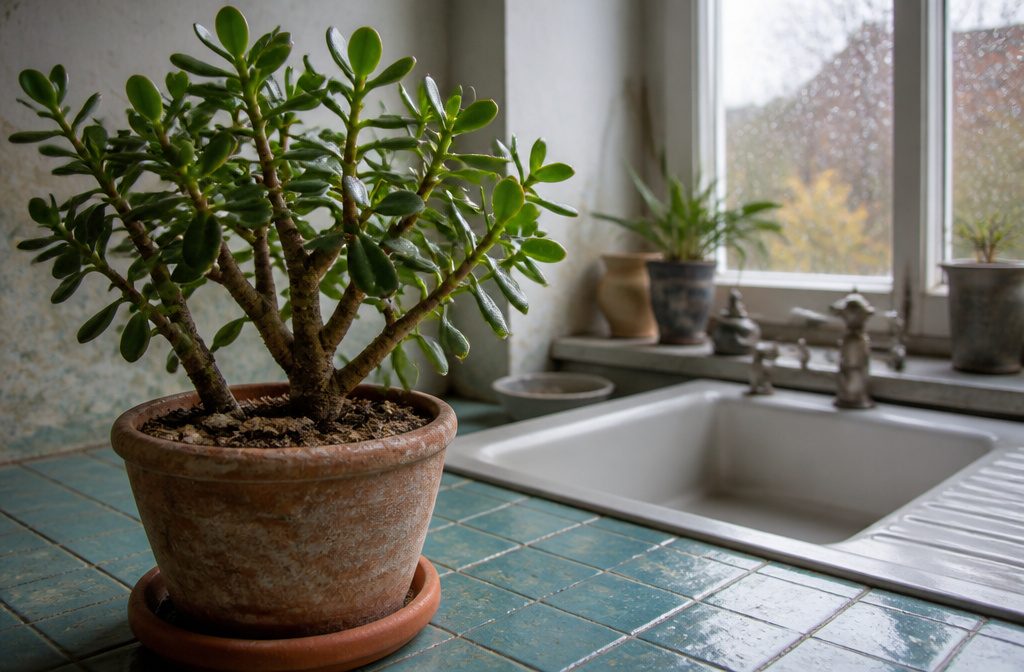
Jade plants grow slowly but reliably—up to 2 inches a year—if you get the water timing right, and that timing is where most attempts fail.
The test is simple: stick your finger 2 inches into the soil, and water only when it feels dry all the way down. Watering before that point causes root rot, which kills more jade plants than any other mistake.
1. Plant the Jade in Well-Draining Soil and a Pot With Drainage Holes

Root rot is the jade plant’s most common killer, and the soil determines whether your plant survives or drowns. A well-draining mix is non-negotiable.
Cactus mix is the simplest answer, already loaded with coarse sand, perlite, or pumice to keep water moving through. If you start with regular potting soil, cut it with one part perlite to two parts soil.
That combination drains fast but may be too light to anchor a top-heavy jade, so consider adding gravel to the pot bottom for ballast.
Traditional all-purpose potting soil holds too much moisture and should be skipped entirely. Jade plants prefer slightly acidic soil around 6.0 pH; alkaline soil can kill them outright.
The pot itself matters as much as what goes in it.
Drainage holes in the bottom are mandatory, giving excess water an exit and allowing airflow so the soil dries between waterings. Terracotta pots wick moisture away faster than plastic and help prevent that wet-feet condition that rots roots from below.
2. Give It Bright Light for at Least 4 to 6 Hours Daily

Jade plants need at least 4 to 6 hours of bright light daily to stay compact and full. Without it, growth turns weak and stretched, a condition called leggy, and the plant loses its bushy shape.
I prefer direct light when possible—sources agree on the hours but split on whether direct sun is safe. Some say the plant tolerates it, especially morning light, while others warn that direct rays can scorch the leaves.
The disagreement matters less if you acclimate gradually: start the plant in bright indirect light near an east, south, or west window, then shift it closer to direct sun over a few weeks if you want to push for fuller growth.
A north window usually runs too dim.
One sign the plant is getting enough: the leaf edges develop a faint red outline.
If the foliage stays dark green and flops over, move it closer to the window. Rotate the pot every few weeks so all sides get exposure and the plant doesn’t lean hard toward the glass.
3. Water When the Top 2 Inches of Soil Are Dry
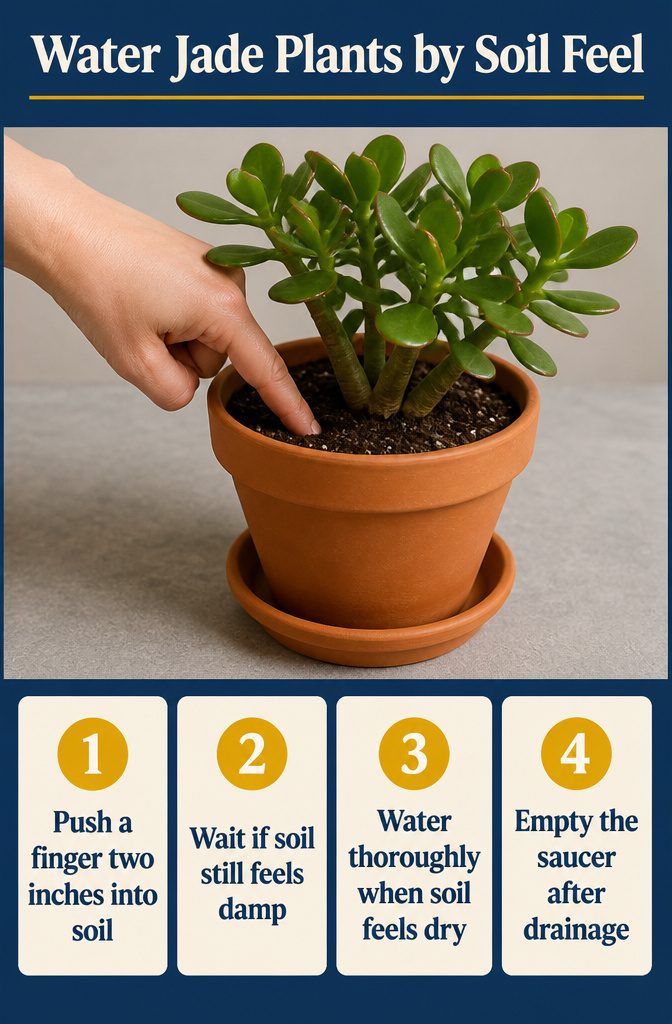
The test for when a jade plant needs water is as straightforward as it gets: stick your finger about two inches down into the soil. If it still feels damp, wait.
If it feels dry, give it a thorough drink until water runs out the drainage holes at the bottom. Never let water sit in a saucer underneath the pot, and never water on a schedule.
Never water on a schedule. Simply poke your finger into the potting medium before watering. If it feels dry a few inches deep, go ahead and give it a good drink until water runs out the bottom of the pot.
That finger test keeps you ahead of the biggest killer of jade plants: overwatering. Root rot is nearly always fatal once it takes hold, and jade stores enough water in its thick leaves to go weeks between drinks.
Indoors, watering every two to three weeks is typical during spring and summer when the plant grows actively.
In fall and winter, stretch that interval out to three or four weeks as growth slows. Pot size, light intensity, and indoor humidity all shift the timing, so the soil check matters more than the calendar.
4. Keep Temperature Between 60 and 75°F
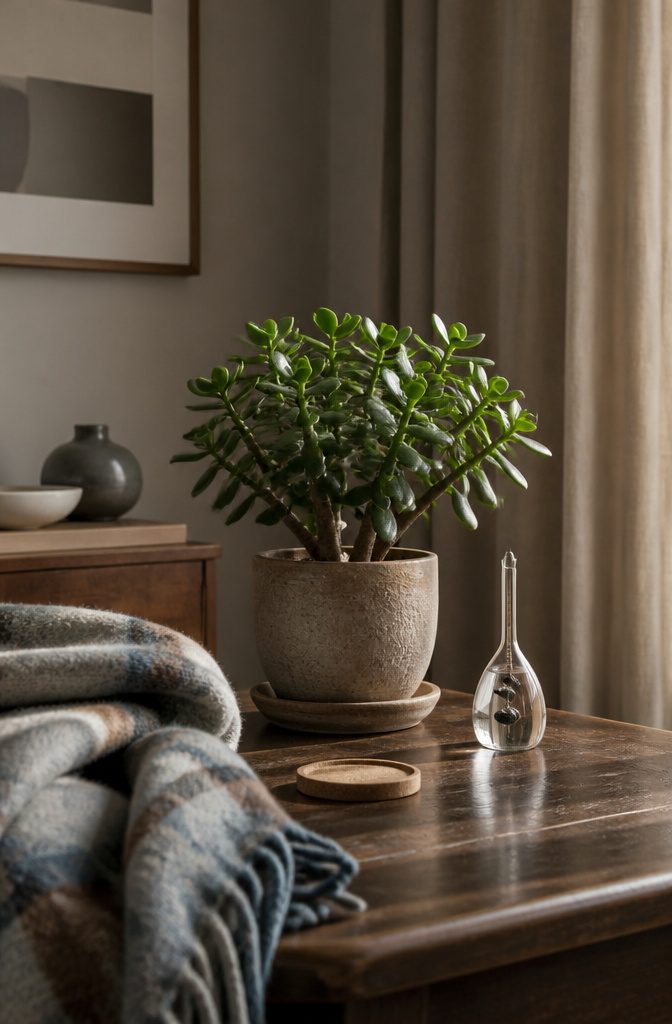
Jade plants do well at average room temperatures between 60 and 75°F, roughly what most households already maintain. The range is forgiving enough that slight fluctuations won’t hurt the plant, but cold drafts and freezing temperatures will.
If you moved your jade outdoors for the summer, bring it back inside before frost arrives. Freezing kills these succulents outright.
Keep jade away from vents, radiators, and open windows in winter.
Direct heat or cold air disrupts the steady conditions the plant prefers. Cooler nights are fine and actually suit jade plants well, so turning the thermostat down at bedtime works in your favor.
If you want to coax an older jade into bloom, place it in a chilly room that gets sunlight during the day but stays unlit at night, holding the temperature between 55 and 60°F for six weeks before returning it to normal warmth.
5. Feed Sparingly During the Growing Season

Jade plants ask for very little fertilizer, and timing matters more than frequency. Most growers feed once a month during spring and summer, though some push it to every two weeks.
The formulation stays the same either way: a balanced liquid fertilizer such as 20-20-20 or 10-10-10, diluted to half the strength the label calls for.
If you prefer a cactus-and-succulent formula like 1-7-6, mix it at full label strength and apply it on the same schedule.
I stop feeding completely in fall and winter.
Jade plants rest during the cooler months, and fertilizer during dormancy does more harm than good. When you do feed, make sure the soil is slightly moist first—fertilizing dry soil can burn the roots.
6. Repot Every 2 to 5 Years Depending on Plant Size

Younger jade plants need repotting every 2 to 3 years, while mature ones can go 4 to 5 years before they need a larger pot. I repot in early spring when the plant is gearing up for its growing season.
The timing matters less if you like your jade’s current size—these plants tolerate being root-bound without much complaint, so you can skip repotting altogether if the pot still drains well and the plant looks healthy.
After repotting, wait about a week before watering.
Roots get cut or damaged during the move, and they need time to dry and callous over. Watering too soon invites rot, which can take down an otherwise sturdy jade.
I also hold off on fertilizer for at least a month, giving the roots time to settle into the new soil and recover from the disruption before asking them to process nutrients again.
7. Watch for Mealybugs, Scale, and Spider Mites
Mealybugs, scale insects, spider mites, thrips, and aphids all show up on jade plants, though none are especially common.
Mealybugs leave white, fuzzy patches where leaves meet stems; scale looks like tiny brown bumps on foliage. Spider mites and thrips usually arrive when indoor air is dry.
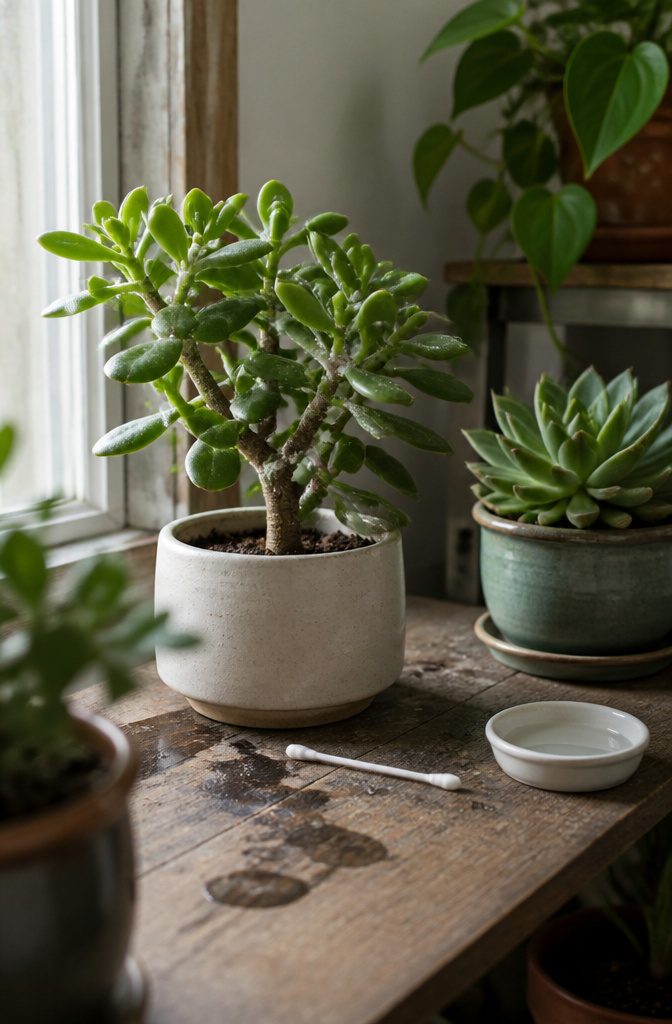
I treat scale and mealybugs the same way: dip a cotton swab in rubbing alcohol and dab each insect directly, working into the crevices and under leaves where they hide.
For spider mites and thrips, a strong spray of water knocks them off outdoors—just cover the soil first so you don’t soak it. Water mixed with mild soap works for lighter infestations; neem oil handles heavier ones.
Insecticidal soap damages jade foliage, so I skip it. Isolate any plant showing pests so the problem doesn’t spread.
8. Diagnose Leaf Problems by Checking Watering and Light
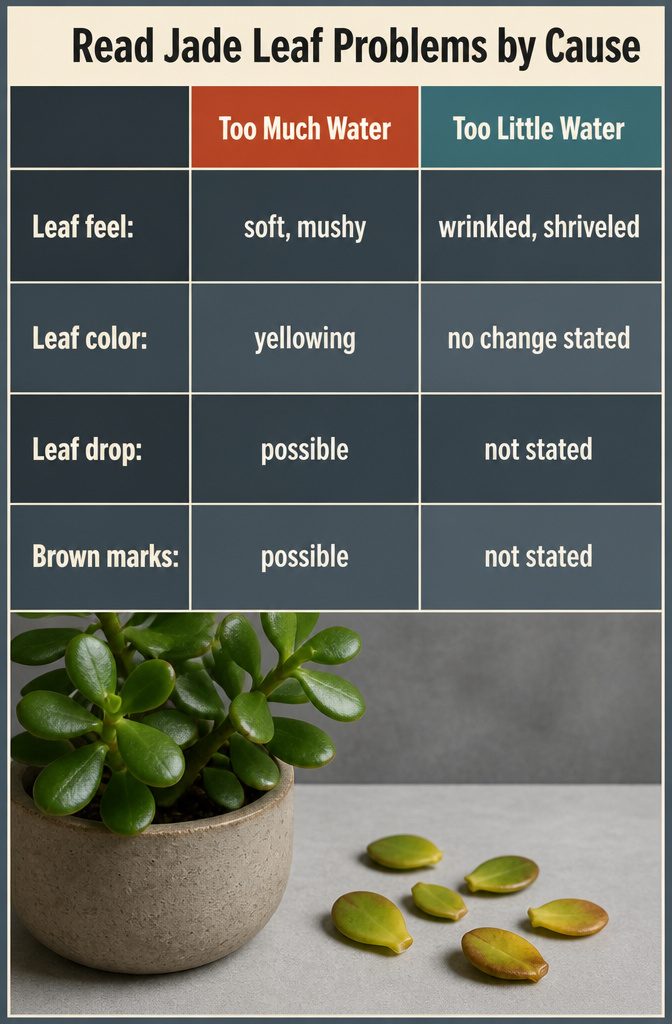
Soft, mushy leaves almost always mean too much water or root rot starting. The tissue fills past capacity, then breaks down.
Yellowing follows the same pattern: when jade stays wet too long, roots suffocate and leaves shed chlorophyll. If the pot feels heavy but the surface reads dry, drainage failed somewhere.
Wrinkled or shriveled leaves point the other direction.
The plant pulled its reserves down and the soil gave nothing back. A deep watering usually plumps them within a day or two.
Leaf drop traces to more than one cause.
Overwatering triggers it, but so does a sudden temperature swing or a spot with too little light. Brown spots or scorched edges show up when direct sun hits the leaves for hours.
Jade tolerates some morning rays, but afternoon intensity burns. If new brown marks appear after a location change, pull the plant back from the window or add a sheer layer between glass and foliage.
Propagate From Stem Cuttings or Leaves in Spring and Summer
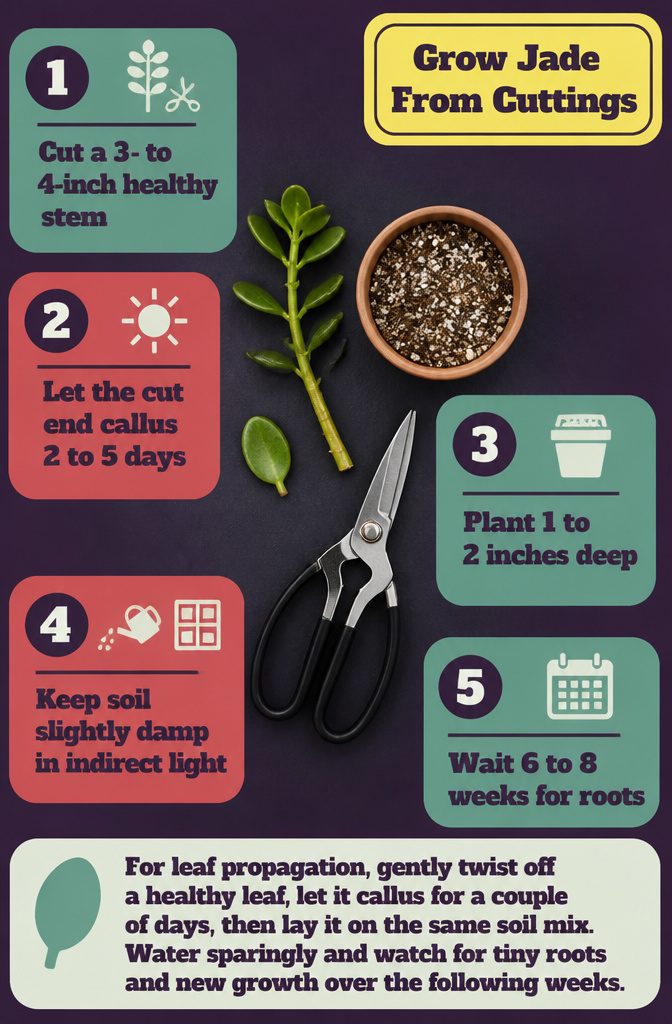
- Cut a 3- to 4-inch stem from a healthy jade plant in spring or early summer using sterilized scissors or shears.
- Let the cut end dry in a warm, airy spot out of direct sunlight for 2 to 5 days until a callus forms over the wound. This prevents rot.
- Mix half perlite and half succulent soil in a pot with drainage holes, then insert the stem 1 to 2 inches deep.
- Keep the soil slightly damp and place the cutting in bright, indirect light.
- Wait 6 to 8 weeks for roots to develop. During this period, maintain temperatures between 65°F and 75°F.
For leaf propagation, gently twist off a healthy leaf, let it callus for a couple of days, then lay it on the same soil mix. Water sparingly and watch for tiny roots and new growth over the following weeks.
Prune in Spring to Early Summer to Control Shape
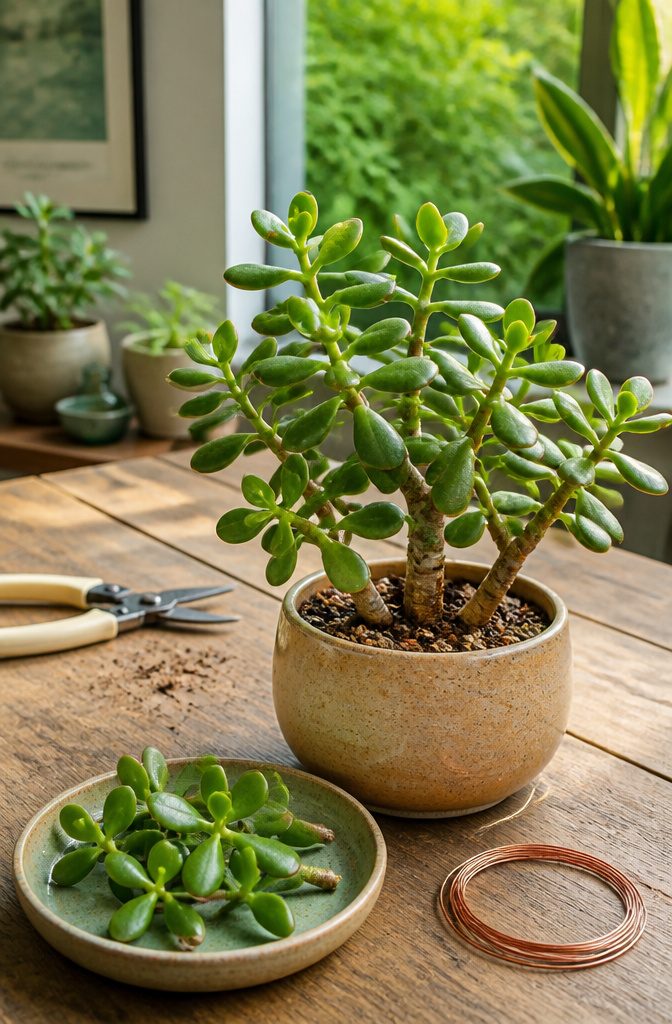
Pruning keeps a jade plant compact and balanced instead of letting it stretch into a leggy or top-heavy shape. The work can be done once a year or whenever you notice uneven growth, so there’s no rigid schedule to follow.
Spring to early summer is the best window because the plant is actively growing and will heal cleanly where you cut.
If you’re shaping a jade for bonsai, wiring can guide the branches into the form you want.
The soft bark on jade stems means wire can dig in and scar the plant if it’s left on too long, so checking every few weeks matters more here than it does with woody bonsai species.
Copper or aluminum wire works fine; just remove it before it starts cutting into the stem.
Skip Misting: Average Indoor Humidity Is Fine
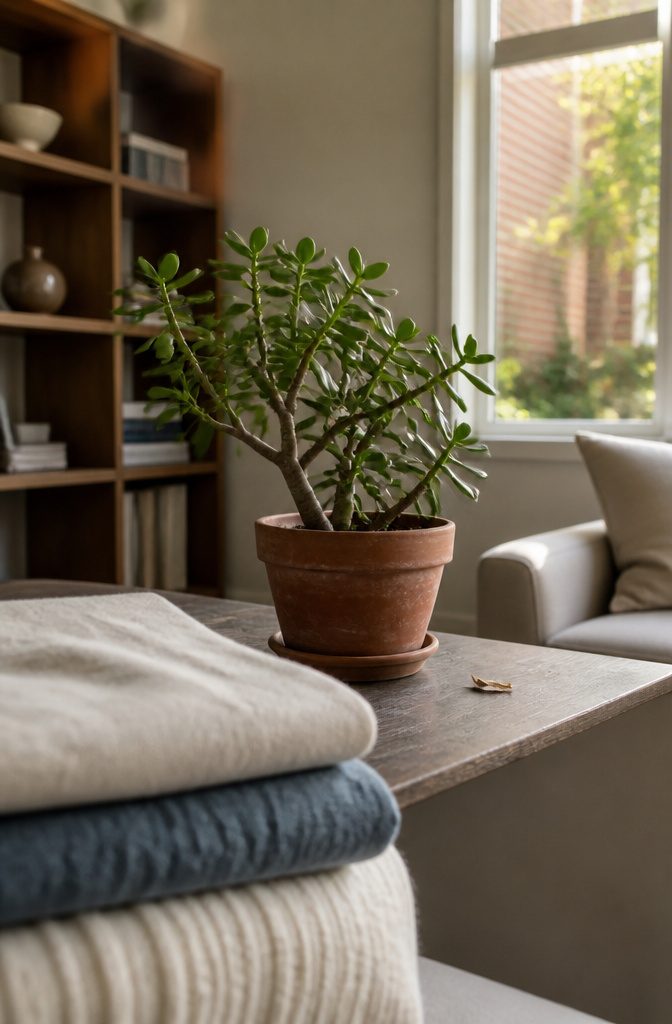
Jade plants do well in average indoor humidity of 30–50%, which is what most homes already sit at. They come from arid climates, so dry air does not bother them the way it would a fern or a calathea.
High humidity can actually cause problems: too much moisture in the air raises the risk of fungal issues and rot, especially if paired with overwatering or poor air circulation.
Misting is generally unnecessary. One approach does call for winter misting as a way to hydrate the plant without soaking the soil, but that is the exception rather than the rule.
Most of the time, proper watering through the soil gives the plant what it needs, and misting the leaves only adds moisture where it is not wanted.
If your home runs dry in winter, a jade will tolerate it better than most houseplants.
Skip the humidifier, the pebble tray, and the spray bottle. Your jade is fine with the air you already have.
Keep Jade Out of Reach: All Parts Are Toxic

Most sources agree that all parts of the jade plant are toxic if ingested, containing a compound called Bufadienolide that can trigger vomiting, diarrhea, depression, incoordination, lethargy, and slowed heart rate in both people and pets.
The sap can also irritate skin enough to cause a rash. One source lists jade as not known to be toxic, so the information conflicts.
Given that most warnings line up and the symptoms can be serious, keeping the plant out of reach of young children and pets is the safer call.
If you suspect ingestion, contact a vet or doctor immediately. Wear gloves if you prune or take cuttings to avoid skin contact with the sap.
Popular Varieties: Gollum, Hummel’s Sunset, and Tricolor

The standard ovata is not your only choice.
Crassula ovata ‘Gollum’ has thick tubular leaves with red-tinted tips that look like suction-cupped fingers, growing to 3 feet. ‘Hummel’s Sunset’, also called golden jade, holds yellow leaves with red edges in full sun and reaches the same height. ‘Tricolor’ stays smaller at a foot or more, with green leaves streaked in white or yellow and outlined in pink. ‘Variegata’ is similar but swaps the pink for cream variegation.
Crassula ovata Minor, E.T.’s Fingers, Blue Bird, Harbor Lights, Lady Finger, and Lemon and Lime add more shapes and colors to the mix.
Portulacaria afra, often sold as dwarf jade or elephant bush, is a separate species with smaller, thinner leaves.
Care overlaps with ovata but afra tolerates pruning and drought better and is less sensitive to overwatering, which makes it more forgiving for beginners.
Expect Slow Growth: Up to 2 Inches a Year

Jade plants are famously slow growers, adding up to 2 inches a year once settled.
That pace means patience pays off: a healthy plant can live 50 to 70 years or longer, eventually reaching 3 to 6 feet indoors. Outdoors in USDA Zones 10 and 11, they can push past 10 feet given enough time and warmth.
Flowers are possible but rare on young plants. Blooms—small clusters of pink or white stars at the branch tips—show up more reliably on specimens 10 years or older, and outdoor plants flower more readily than indoor ones.
The reason comes down to night length: jade needs long stretches of darkness to trigger blooming, something easier to come by outside than in a room with evening lights on.
Frequently Asked Questions
How often should I water a jade plant?
Water when the top 2 inches of soil feel dry to the touch, which typically works out to every 2 to 3 weeks during spring and summer.
In fall and winter, stretch that interval to 3 or 4 weeks as growth slows. Always check the soil with your finger rather than following a schedule.
Why are the leaves of my jade plant falling off?
Leaf drop usually traces back to overwatering, though sudden temperature changes or insufficient light can also trigger it.
Check that the soil is not staying wet too long and that the plant is getting at least 4 to 6 hours of bright light daily. Once conditions stabilize, the plant typically recovers.
Can jade plants live outside?
Jade plants can live outdoors in USDA Zones 10 and 11, where they may eventually grow past 10 feet. In cooler climates, bring them inside before frost arrives since freezing temperatures kill them outright.
What is the lifespan of a jade plant?
A healthy jade plant can live 50 to 70 years or longer with proper care. They grow slowly, adding up to 2 inches per year, so patience pays off over decades.
Can jade plants get too much sunlight?
Yes, intense direct sun can scorch the leaves and cause brown spots or burned edges.
Morning light is generally safe, but if new brown marks appear after moving the plant, pull it back from the window or filter the light with a sheer layer.
Do jade plants like to be misted?
No, jade plants do not need misting and do well in average indoor humidity of 30 to 50%. High humidity can raise the risk of fungal issues and rot, so skip the spray bottle and water through the soil instead.
Why are my jade plant leaves soft, wrinkled, or shriveling?
Soft or wrinkled leaves usually mean the plant needs water, as it has pulled down its reserves and the soil is too dry.
A deep watering should plump them back up within a day or two. If the soil is already wet, the problem may be root damage from overwatering.
Can jade plants survive in low light?
Mature jade plants of at least 10 years may tolerate low light if gradually adjusted, but they will not thrive. Growth weakens and stretches without at least 4 to 6 hours of bright light daily, and the plant loses its compact shape.
Does a jade plant need fertilizer?
Yes, but sparingly.
Feed once a month during spring and summer using a balanced liquid fertilizer diluted to half strength. Stop feeding completely in fall and winter when the plant rests, as fertilizer during dormancy does more harm than good.
How fast does a jade plant grow?
Jade plants grow slowly, adding up to 2 inches per year once settled. Jade plants grow most quickly in warm, bright conditions during spring and summer, and slow down in cooler months or low light.